
The lighting company that stopped making lights
In today's edition, we talk about how India's biggest lighting company sold its own factory, booked a ₹91 crore windfall, and quietly became a trading business.
Walk into any electrical shop in India and ask for a bulb. Odds are you'll be handed a Philips.
That bulb is sold by a company called Signify Innovations India Limited — the old Philips Lighting India, renamed after the Dutch parent split off its lighting arm in 2016. It's the market leader. It did ₹3,289 crore of revenue last year. And its returns are the sort of thing that make analysts sit up: ROCE of 79.5%.
Now here's the twist.
That bulb? Signify didn't make it.
Not anymore.
Because in August 2025, Signify did something unusual for a manufacturer. It sold its own factory. And then it turned around and started buying its own products back from the buyer.
Sounds strange? Let's unpack it.
Before we get to the factory, let's look at how FY26 actually went.
| Particulars | FY26 | FY25 | Change |
|---|---|---|---|
| Revenue | ₹3,288.8 cr | ₹3,113.6 cr | +5.6% |
| EBITDA | ₹517.6 cr | ₹448.3 cr | +15.5% |
| OPM (%) | 15.7% | 14.4% | +134 bps |
| PBT | ₹484.3 cr | ₹366.3 cr | +32.2% |
| PAT | ₹372.0 cr | ₹270.1 cr | +37.7% |
| EPS | ₹64.68 | ₹46.96 | +37.7% |
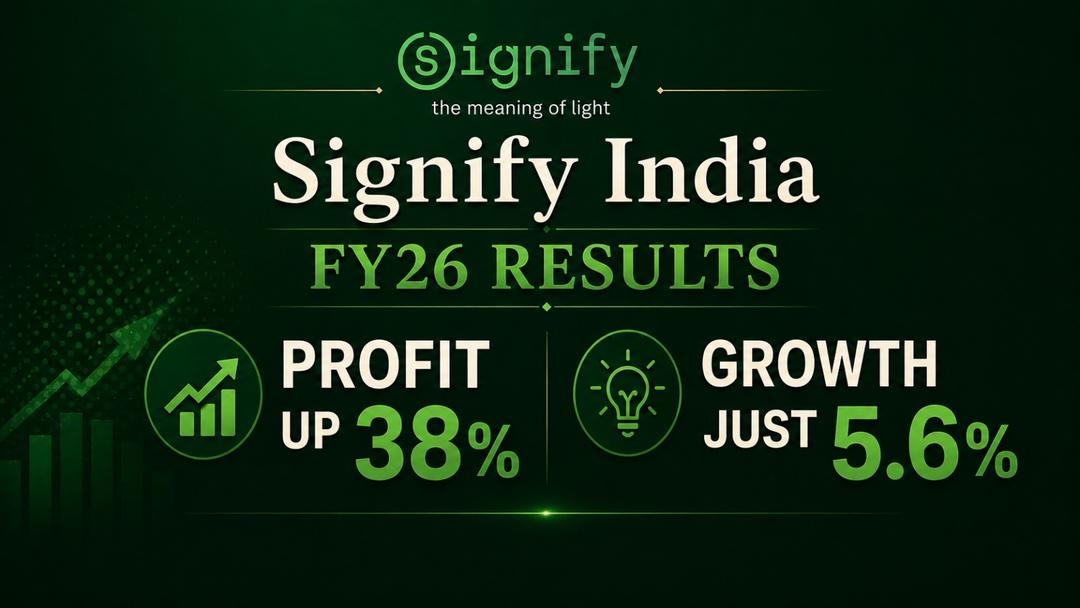
Profit up 38%. Margins up. EPS up. Looks like a blowout year, right?
Hold that thought. We'll come back to it.
Signify reports as a single segment, but it's really running four different engines, and they're going in very different directions:
Consumer (B2C) — Philips bulbs at the premium end, EcoLink at the value end, plus decorative lighting and now BLDC ceiling fans. Grew double digits. Expanded to 345+ Philips Smart Light Hubs and sponsored two IPL teams to push EcoLink.
Professional (B2B/B2G) — the project business. Lit up Jodhpur, Udaipur, Guwahati and Thoothukudi airports, the Varanasi stadium, the Samayapuram Temple façade. Grew only single digits.
Conventional lighting — the old filament and tube-light business. Shrinking, deliberately. Management's word for the strategy is "maximise value while managing its natural decline."
Captive global services — this one's interesting. Signify India runs a Global Finance Service Centre in Noida, a Global Digital Centre in Bengaluru, and Cooper Lighting operations in Pune. They bill the Dutch parent for it. ₹525.2 crore of revenue — 100% of it from group companies.
That last one matters more than it looks. We'll get there.
Signify owned the Vadodara Light Factory in Gujarat. Part of it made LED products.
Owning a factory is expensive. Machines. Workers. Upgrades every few years. Fixed costs that don't care whether your sales are good.
So Signify found a partner: Dixon Technologies — India's largest contract electronics manufacturer, the company that builds phones and TVs for brands that don't want their own plants.
Here's what they did:
Set up a new company, Lightanium Technologies, owned 50:50
Signify sold its LED factory business to Lightanium for ₹150 cr
Signify put ₹145.6 cr of cash back in to buy its 50% stake
Signify kept the land and now rents it to Lightanium (₹4.7 cr of rent last year)
Signify now buys the finished products back — ₹302.1 cr worth in year one
Notice the elegance. The ₹150 cr Signify received almost exactly funded the ₹145.6 cr it invested. The entire restructuring cost roughly nothing in net cash.
And it booked a ₹90.9 crore gain on the sale.
Remember we said hold that thought?
That ₹90.9 crore gain sits inside the reported PBT. It happens once. It will never happen again.
Here's what the exceptional line actually looked like:
| Exceptional item | FY26 |
|---|---|
| Gain on selling factory to JV | +₹90.9 cr |
| Voluntary retirement scheme | –₹38.0 cr |
| New Labour Codes — gratuity | –₹18.8 cr |
| New Labour Codes — leave | –₹6.3 cr |
| Net | +₹27.8 cr |
Strip the one-timers out and PBT before exceptionals grew 22.5%, not 32.2%. Adjusted PAT is around ₹348 cr — still a good year, just not a spectacular one.
Two of those negative lines deserve a mention:
The ₹38 cr VRS was because conventional lighting is dying. 210 employees took voluntary retirement.
The ₹25.1 cr labour code hit came from the government notifying four new Labour Codes in November 2025. The definition of "wages" got wider, which means gratuity and leave liabilities got bigger. This one isn't a one-off — it's a permanent cost step-up, and the final rules are still pending.
Signify grew 5.6%.For the market leader in lighting, that's slow. Here's why.
1. One. One business is dying.
Consumer grew fast. Projects grew slowly. Old-style lamps are shrinking — 210 people took VRS, costing ₹38.0 cr.
Two engines pulling forward. One pulling back.
2. Two. Big projects aren't coming in.
Win a contract, and the client asks your bank for a guarantee. More projects means more guarantees.
Signify's guarantees fell — ₹192.1 cr to ₹186.4 cr.
Management talks about government spending. The number says something else.
3. Three. A fifth of the money can't grow faster.
Signify India also does back-office work for its Dutch parent. Billed: ₹525.2 cr.
But the price is fixed by a formula — costs plus a set margin. It's mostly salaries. So it grows only when they hire.
Indian demand doubles? This part doesn't move.
Add ₹159.0 cr of exports to the parent, and 21% of sales sits outside the India story.
4. Four. Spending more, growing less.
Ad spend up 30% to ₹49.8 cr. 345+ stores. Two IPL teams.
All that bought 5.6%.
And money owed by customers rose 24.7% — four times faster than sales. So part of the growth is just longer credit.
5. Five. The LED wave is over.
The report doesn't say this, but the numbers hint at it. Everyone switched to LED at once. And an LED bulb lasts years before you replace it.
The rush already happened.
So FY26 wasn't a growth story.
Profit grew 15.5%. Sales grew 5.6%. The gap came from cutting the weak business and selling the factory.
But you can only cut costs once.
On paper, handing manufacturing to Dixon looks smart. Signify gets a lighter balance sheet, better costs, and still owns half the factory.
But look at what Lightanium actually is:
| Lightanium (100% basis, part-year) | Amount |
|---|---|
| Revenue | ₹814.0 cr |
| PAT | ₹10.5 cr |
| Net margin | 1.3% |
| Total liabilities | ₹558.2 cr |
₹814 crore of sales. ₹10.5 crore of profit. That's a 1.3% margin, against Signify's own 11.3%.
Which tells you exactly why Signify was happy to hand it over. Manufacturing bulbs is a rotten business. Selling them under the Philips name is a great one.
Signify's share of that profit was ₹5.6 cr, and only ₹4.2 cr made it into the P&L — the rest got cancelled out because part of Lightanium's profit came from selling to Signify, and you can't book profit on selling to yourself.
There's one more thing worth noticing. Because Signify owns exactly 50% and not more, Lightanium's accounts don't get merged into its balance sheet. Which means ₹558 crore of the JV's liabilities, its bank loans and ₹59 cr of letters of credit never show up in Signify's ₹1,748 crore balance sheet.
Signify's legal risk is capped at its ₹151 cr investment. But the business it now depends on for its products is a lot bigger than the accounts suggest.
Here's the part most people miss.
Signify Holding B.V. owns 96.13% of this company. The public float is under 4%.
And money moves between India and Netherlands in both directions:
| Flow | Amount (FY26) |
|---|---|
| Services billed to group companies | ₹525.2 cr |
| Products exported to Signify Netherlands | ₹159.0 cr |
| Total related-party revenue | ₹701.7 cr (21.3% of sales) |
| Technical royalty paid to Signify Netherlands | ₹123.7 cr |
| IT services bought from group | ₹43.5 cr |
| Management support charges | ₹21.9 cr |
| Dividend paid out | ₹301.97 cr |
So roughly one in five rupees of revenue comes from the parent's own group, and about 3.8% of revenue goes straight back out as royalty for using the technology and the brand.
Which brings us to a live risk. The income tax department has already raised demands of ₹11.7 cr for AY 2021-22 and 2022-23, largely on transfer pricing. And for AY 2023-24, Signify has received a transfer pricing order but hasn't disclosed the amount because the final assessment hasn't landed yet.
That's an unsized liability sitting off the books.
The GST problem is growing. Contingent liabilities from Signify's own indirect tax disputes jumped from ₹20.4 cr to ₹48.7 cr — more than doubling — driven mostly by allegations of excess input tax credit claims.
Customers are paying slower. Trade receivables rose 24.7% while revenue rose 5.6%. Receivables overdue by more than 90 days doubled, from ₹17.3 cr to ₹35.5 cr.
Suppliers are funding the business. Payable days stretched from 144 to 167. The cash conversion cycle is now negative 70 days, up from negative 45. Trade payables of ₹758.6 cr exceed the company's entire net worth of ₹503.9 cr.
The books are kept abroad. The secretarial auditor flagged that Signify's accounting servers sit outside India, so daily backups in India aren't happening — a Companies Act compliance gap the company says it's "evaluating."
Look at the balance sheet and it's genuinely impressive:
| Item | FY26 |
|---|---|
| Cash & bank | ₹498.2 cr |
| Borrowings | Nil |
| Capex for the year | ₹42.0 cr |
| Operating cash flow | ₹494.2 cr |
| Free cash flow | ₹452.2 cr |
| Dividend paid | ₹301.97 cr (81% of PAT) |
Zero debt. Half a thousand crore in the bank. Capex of just 1.3% of revenue. Free cash flow of ₹452 crore from a business that barely owns any factories.
That's the whole point of the pivot. Signify has turned itself into a brand-and-distribution company that designs lighting, sells it through 345 Smart Light Hubs and a project sales force, and lets someone else deal with the machines.
The trade-off is that it now owns less of its own value chain. Its manufacturing sits in a low-margin JV. Its technology comes from the Netherlands at a price the tax department is scrutinising. And a fifth of its revenue depends on its own parent choosing to keep the work in India.
Whether that's clever capital allocation or quiet hollowing out probably depends on what you think a lighting company is supposed to be.
For now, the returns say clever.
Until next time…
Source: Signify Innovations India Limited, Annual Report FY 2025-26 (standalone and consolidated financial statements, Directors' Report and annexures). All figures converted from ₹ million to ₹ crore.