
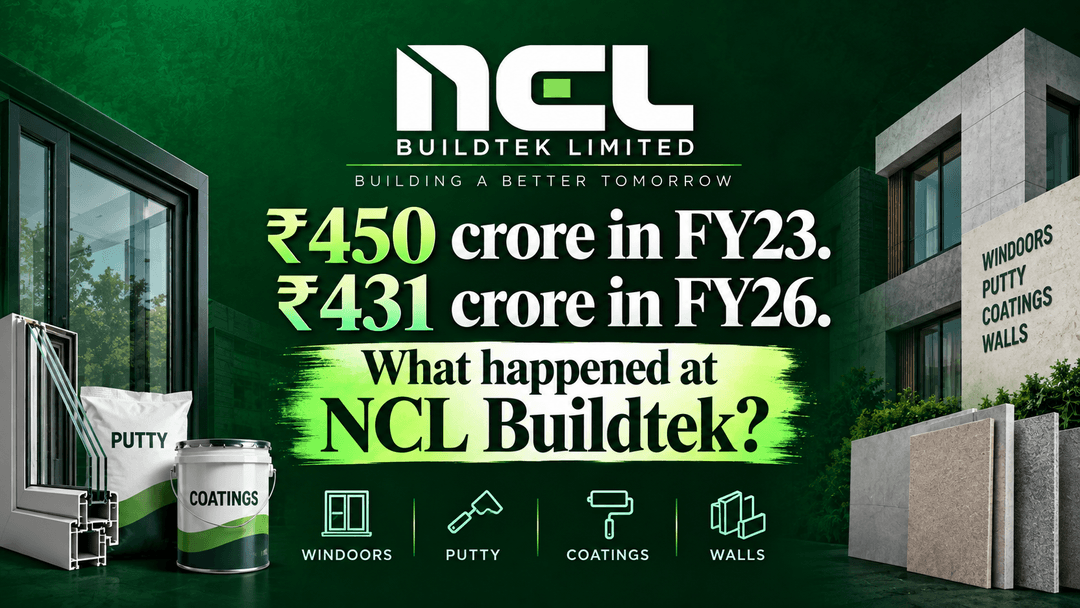
It's the building-materials arm of Hyderabad's NCL Group, the same promoter family behind NCL Industries (the cement company). NCL Buildtek is unlisted — the FY26 report says the Board has decided to defer its listing plans because management doesn't currently see a need to raise funds through a public issue.
The business is a one-stop building-materials shop with three reportable segments:
1. Windoors — the biggest one. Colour-coated GI profiles (CCGI, essentially steel roofing and structural profiles), uPVC windows and doors, aluminium windows and doors, ABS doors, and from FY25, steel doors.
2. Coatings — wall putty, paints, textures, and tile adhesives.
3. Walls — AAC blocks (aerated fly-ash blocks), the lightweight bricks used in modern construction.
Plants sit in Telangana (Mattampalli, Ratnapuri, Gundlapochampally), Andhra Pradesh (Kondapalli, Amudalapadu) and Rajasthan (Keshwana). It sells to builders, contractors and dealers, and it's heavily concentrated in South India, with a growing north push through Coatings.
Now here's where it gets interesting.
This is the table that explains everything. All figures in ₹ crore, taken from the segment reporting notes of the FY24 report (for FY23 and FY24) and the FY26 report (for FY25 and FY26).
Segment | FY23 | FY24 | FY25 | FY26 |
|---|---|---|---|---|
| Windoors | 223.8 | 213.3 | 202.6 | 220.4 |
| Walls (AAC blocks) | 125.0 | 126.5 | 102.7 | 100.7 |
| Coatings | 101.6 | 95.6 | 98.8 | 109.9 |
| Total | 450.4 | 435.5 | 404.2 | 431.0 |
Four years. Revenue starts at ₹450 crore and ends at ₹431 crore. It has gone precisely nowhere.
Segment | FY23 | FY24 | FY25 | FY26 |
|---|---|---|---|---|
| Windoors | 20.0 | 18.5 | 13.2 | 0.6 |
| Walls (AAC blocks) | 2.0 | 7.5 | 1.3 | 0.6 |
| Coatings | 13.4 | 12.4 | 10.5 | 11.6 |
| Total segment result | 34.8 | 38.4 | 25.0 | 12.8 |
| Less: finance cost | 16.6 | 15.4 | 12.7 | 11.4 |
| PBT from ordinary activities | 18.2 | 23.0 | 12.3 | 1.4 |
And this is where flat revenue turns into a genuine problem. Segment profit has fallen by two-thirds in two years. Profit before tax from ordinary activities is down from ₹23 crore to ₹1.4 crore.
Segment | FY23 | FY24 | FY25 | FY26 |
|---|---|---|---|---|
| Windoors | 8.9% | 8.7% | 6.5% | 0.3% |
| Walls | 1.6% | 6.0% | 1.2% | 0.6% |
| Coatings | 13.2% | 13.0% | 10.6% | 10.5% |
Two of the three segments now make essentially zero money. Only Coatings has held its shape.
₹ crore | FY23 | FY24 | FY25 | FY26 |
|---|---|---|---|---|
| Revenue & other income (gross) | 453.6 | 437.1 | 406.7 | 434.6 |
| EBIDTA | 45.9 | 49.7 | 37.8 | 26.6 |
| PBT excluding exceptional items | 18.2 | 23.0 | 12.3 | 1.4 |
| PAT (reported) | 13.5 | 15.9 | 68.4 | 0.9 |
| EPS excluding exceptional items (₹) | — | 13.76 | 7.42 | 0.70 |
Ignore that ₹68.4 crore PAT in FY25. It's not real operating profit — we'll come to it in a minute. EPS excluding exceptional items is the honest line: ₹13.76 → ₹7.42 → ₹0.70.
Here's the sentence in the FY26 MD's letter that most people would skim past:
Since FY23, the CCGI business has declined by approximately ₹75 crore as the market has progressively shifted from CCGI to uPVC.
CCGI — colour-coated steel profiles — was the backbone of Windoors. Over three years, ₹75 crore of it evaporated because customers moved to uPVC windows.
And separately, the Blocks business declined by approximately ₹25 crore amid intense competition from local and unorganised players.
Add those up: ₹100 crore of revenue disappeared. Yet the total topline barely moved, from ₹450 crore to ₹431 crore.
That's the key insight. NCL Buildtek's flat revenue isn't stagnation. It's a ₹100 crore hole that got refilled with new products — aluminium, uPVC, steel doors, tile adhesives. The company genuinely did adapt. Management deserves credit for the pivot itself.
The problem is what it refilled the hole with.
CCGI was a reasonably profitable product. uPVC is a commodity fight.
Read what the MD says about FY26: a significant portion of the uPVC business was written at pricing levels that did not adequately reflect the underlying cost structure and required margins. It supported revenue and volume, but hammered division profitability.
And the Directors' Report is even more blunt. In the section explaining why the company needs shareholder approval to pay managerial remuneration despite inadequate profits, it states that FY26 profits were inadequate despite higher revenue, primarily due to pricing pressure in Windoors arising from aggressive pricing in the project segment and intense market competition.
Look at what that produced. Windoors revenue actually grew ₹18 crore in FY26, from ₹202.6 crore to ₹220.4 crore. Its profit fell from ₹13.2 crore to ₹0.6 crore.
That is the definition of buying revenue. The division sold more and earned nothing.
Now put it next to the balance sheet. Segment assets employed in Windoors:
Segment assets (₹ cr) | FY24 | FY26 |
|---|---|---|
| Windoors | 200.4 | 286.3 |
| Walls | 109.0 | 92.3 |
| Coatings | 52.7 | 60.4 |
The company put an extra ₹86 crore of assets into Windoors between FY24 and FY26. In FY24 those assets produced ₹18.5 crore of segment profit. In FY26, a bigger asset base produced ₹0.6 crore.
Return on segment assets, FY26: Coatings 19%, Walls 0.6%, Windoors 0.2%.
This is the part you can only see by reading both reports together.
In the FY24 report, under material changes, there's a long paragraph about NCL Veka Pvt Ltd — a joint venture with Veka AG of Germany, in which NCL Buildtek held 23.70%. Veka AG is one of the world's large uPVC profile manufacturers. That JV is where the uPVC profiles came from.
The FY24 report describes a fight. NCL Buildtek issued an Exit Notice under the shareholders' agreement. Veka AG responded with a Call Notice to buy NCL Buildtek's 62,31,799 shares at ₹138.78 each. The Board thought the price was too low and counter-offered to buy out Veka AG instead at 90% of the call price. Veka AG contested on technical grounds. It went to arbitration, and as of the FY24 report the award was reserved.
The FY24 report spells out both outcomes. If the award upheld Veka AG's claim, NCL Buildtek would have to sell its 62,31,799 shares for ₹86.48 crore. If it upheld the counter-claim, NCL Buildtek would acquire control of the JV for ₹164.26 crore.
Now open the FY26 report. In FY25, the company sold exactly 62,31,799 shares of NCL Veka. That's the first outcome. The sale produced a profit booked as an exceptional item of roughly ₹70 crore — which is the entire reason FY25's reported PAT looks like ₹68.4 crore against underlying profit of about ₹8.6 crore.
And then the consequence, in the FY26 MD's letter: the company has experienced changes in its uPVC profile supply arrangements following VEKA's decision to cease supplying the Company. Alternate sourcing has been arranged, but certain orders already in the pipeline will be executed at lower-than-desired margins.
The Directors' Report frames the new arrangement positively — an alternate extruder diversifies supply risk, reduces concentration risk, and gives better negotiating leverage in a highly competitive uPVC market.
Both things can be true. But strip away the framing and here is the sequence:
The company exits a JV with a German technology partner.
It receives ₹86.5 crore and books a ₹70 crore accounting gain.
The partner stops supplying it.
Its uPVC business, now buying commodity profiles like everyone else, sees margins collapse from 6.5% to 0.3%.
The ₹70 crore was a one-time gain. The loss of differentiation is permanent.
Walls (AAC blocks) tells its own cautionary tale. Read the FY24 MD's letter and it sounds like a turnaround story: the most notable turnaround was in the Blocks division, with EBITDA up 64% from ₹8.7 crore to ₹14.2 crore, driven by better raw material utilisation and R&D. Segment profit hit ₹7.5 crore in FY24.
Two years later it's ₹0.6 crore on ₹100 crore of revenue, with ₹92 crore of assets tied up. The FY26 letter describes intense competition from local and unorganised players causing significant pricing pressure, making the business increasingly challenging to operate sustainably.
AAC blocks are heavy and low-value, so they can't travel far, which means every local plant is a competitor and nobody has pricing power. That FY24 improvement turned out to be an operational efficiency gain, not a durable competitive advantage.
Coatings is the good news, and it's worth pausing on. Revenue ₹101.6 → ₹95.6 → ₹98.8 → ₹109.9 crore. Profit ₹13.4 → ₹12.4 → ₹10.5 → ₹11.6 crore. Margin around 10–13% throughout. It's the only segment that has grown revenue and kept margins, and it earns a ~19% return on its segment assets.
Notably, it's also the smallest segment and the one absorbing the least capital.
Total segment profit in FY26 was ₹12.8 crore. Finance cost was ₹11.4 crore.
Read that again. Almost 90% of what the three businesses earned went to lenders.
To be fair, the balance sheet itself is not stretched. The FY26 report puts net debt at ₹18.5 crore against total equity of ₹227.8 crore — a gearing ratio of 8.13%. A year earlier the company was actually net cash, at negative ₹17.2 crore, largely because of the Veka sale proceeds.
So the issue isn't leverage. It's that ₹104 crore of gross borrowings costs roughly ₹11.4 crore a year in interest, and the operating businesses have stopped generating enough to cover it comfortably. Interest cost has been falling steadily (₹16.6 crore in FY23 to ₹11.4 crore in FY26). Profit has been falling faster.
Pulling it together, four reasons:
1. It's not a growth problem, it's a substitution problem. The company lost ₹100 crore of revenue in CCGI and blocks and replaced it with ₹100 crore of aluminium, uPVC, steel doors and tile adhesives. The topline looks flat because a decline and a growth cancelled out. But the replacement revenue is structurally less profitable than what it replaced.
2. The new businesses are in commodity categories. uPVC is price-sensitive and crowded. AAC blocks compete with unorganised local players. In both, NCL Buildtek is a price-taker.
3. It gave up its one supply advantage. The Veka exit converted a differentiated position into a one-time ₹70 crore gain, and then into a supply disruption and thinner margins.
4. The new bets are small and not yet paying. Steel doors, the flagship FY25 initiative, did about ₹11 crore of gross turnover in its first full year, is not yet profitable, and is running at about 25% capacity per the FY26 Directors' Report. Aluminium output grew about 40% YoY in FY26. Coatings capacity is being relocated within Rajasthan from Chopanki to Keshwana, and a fabrication facility has been commissioned there. All real, all encouraging, none of it large enough yet to move a ₹431 crore company.
And there's one more thing worth flagging. In May 2026, the company incorporated NCL Paints Private Limited, a wholly owned subsidiary that has yet to commence operations. Decorative paints is arguably the single most competitive building-materials category in India right now, with very large, very well-capitalised entrants spending aggressively on capacity and distribution. Entering it while two of your three existing segments earn near-zero margins is a bold sequencing choice.
The FY26 report is unusually candid about the fix. Across the MD's letter and the Directors' Report, the stated actions are: enhanced pricing controls, centralised quotation management, strengthened cost monitoring, improved cross-functional coordination, rationalising low-margin business, improving collections, and better allocation of capital and management resources. Leadership in the Windoors business has been strengthened.
That list is exactly right for the problem diagnosed. Notice what it is, though. Every item on it is about repairing margins, not about growing.
Which brings us back to the cover.
NCL Buildtek is not a company that failed to adapt. It saw CCGI dying, it moved into uPVC and aluminium, it added tile adhesives and steel doors, it kept the topline intact through a genuine structural shift in its market. That's harder than it looks.
But it adapted into commodity categories, funded that adaptation by expanding the Windoors asset base by ₹86 crore, monetised its one differentiated supply relationship for a one-time gain, and now runs two of three segments at roughly zero margin while interest consumes almost everything the business earns.
The honest way to read these two annual reports side by side is this: the topline stayed flat and the profit pool collapsed. Growth isn't the missing ingredient. Pricing power is.
The Coatings division proves the company can earn 10%+ margins when it isn't competing purely on price. Whether that discipline can be transplanted into Windoors — and whether it should be poured into paints next — is the question FY27 will answer.
All figures sourced from NCL Buildtek Limited's Annual Report 2023-24 and Annual Report 2025-26 (standalone financials, segment reporting notes, Directors' Reports and MD's letters). Figures converted from ₹ lakhs to ₹ crore and rounded. This is analysis of publicly filed documents, not investment advice.