
The story of NCDEX's half-year results (April–September 2026). All figures in ₹ crore, consolidated unless stated otherwise.
Picture a soybean trader in Indore, sometime in late 2021.
For years, his mornings followed the same rhythm. Chai, the mandi prices, and then a glance at his screen to see where soybean futures were trading on NCDEX. If he expected prices to fall before harvest, he could lock in a price today. That was the whole point of a commodity exchange: to give farmers, traders and processors a way to protect themselves from wild price swings.
Then one day, the screen went quiet.
Worried about food inflation, SEBI asked NCDEX to stop new trades in some of its biggest contracts. Chana and mustard went first. Soon after, soybean, soy oil and a few others joined the list. Nobody could open fresh positions anymore.
Everyone was told it was temporary. Just one year.
The year passed. The ban was extended. Then extended again. And again. Today, five years later, those contracts are still frozen, and the latest extension runs till March 31, 2027.
For an exchange, this is like a sweet shop being told it can't sell kaju katli or rasgulla. The shop stays open, the lights stay on, the staff still show up. But the customers who came for the best sellers stop coming. And since an exchange earns mainly from the fees on every trade, fewer trades simply means less money.
Particulars (₹ cr) | H1 FY27 | H1 FY26 | Change |
|---|---|---|---|
| Revenue from operations | 54.96 | 38.89 | +41% |
| Other income | 46.39 | 22.74 | +104% |
| Total income | 101.35 | 61.63 | +64% |
| Total expenses | 130.92 | 100.83 | +30% |
| Share of profit from JV | 3.35 | 1.40 | +139% |
| Loss before tax | (26.22) | (37.80) | Narrowed |
| Net loss | (21.60) | (28.03) | Narrowed 23% |
| EPS (₹) | (2.37) | (5.38) | Improved |
NCDEX could have waited for the ban to lift. Instead, it decided to build an entirely new shop next door.
In July 2025, SEBI gave it an in-principle nod to enter the equity and equity derivatives market. That's the arena where NSE and BSE have ruled for decades, the place where millions of Indians trade shares and F&O every day.
But building a stock exchange isn't cheap. You need lightning-fast trading engines, surveillance systems, risk managers and a lot of tech talent, all before the first trade ever happens.
So in October 2025, NCDEX went to investors and raised ₹770 crore, issuing about 3.9 crore new shares at ₹197.34 each.
But there was a catch for these new investors. Their shares came with a 12-month lock-in from the day of allotment, October 7, 2025. For a full year, they could hold the shares but not sell them.
That lock-in ended in October 2026. And when a large batch of shares suddenly becomes free to sell, the market changes overnight. Many of these investors had bought at ₹197.34, and some of them now wanted to book profits. More sellers showed up, and more shares started changing hands.
This is one big reason NCDEX's share price has cooled off sharply, sliding from a peak of about ₹480 to around ₹262. Even after the fall, though, the price is still well above what those lock-in investors paid.
And it kept adding new things to the counter. In July 2026, it launched NCDEX Nidhi, its own mutual fund platform.
Six months into the new financial year, the results are out. So how is the new chapter going?
At first glance, the news looks good.
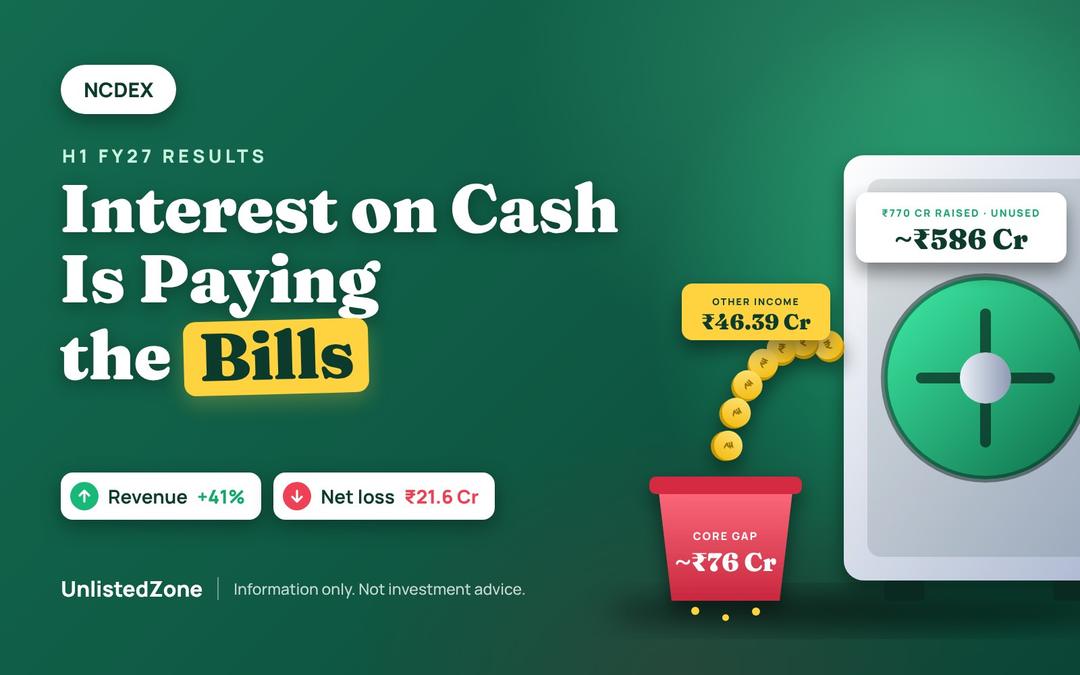
Revenue from operations, the money NCDEX actually earns from running its business, rose 41% to ₹54.96 crore, up from ₹38.89 crore a year ago.
The July–September quarter was even livelier. Revenue hit ₹28.82 crore, nearly 48% higher than the same quarter last year and 10% more than the quarter just before it.
And the loss? It shrank. NCDEX lost ₹21.60 crore in the first half, compared with ₹28.03 crore a year earlier. That's a 23% improvement.
₹ crore | H1 FY26 | H1 FY27 | Change |
|---|---|---|---|
| Revenue from operations | 38.89 | 54.96 | +41% |
| Net loss | (28.03) | (21.60) | Narrowed 23% |
Growing revenue, a shrinking loss. Sounds like a comeback story, right?
Well, not quite. There's a quiet helper hiding in the numbers.
Remember the ₹770 crore NCDEX raised? It hasn't spent most of it yet.
At the end of September, about ₹586 crore of that money was still unused, parked in debt mutual funds, fixed deposits and corporate bonds. And money that sits in safe places earns interest.
So NCDEX's "other income", which is mostly this interest and investment income, more than doubled to ₹46.39 crore. That's nearly half of everything the company earned in these six months.
Think of it like a young couple who've saved up to build a house. While the construction plans are being drawn, their savings sit in an FD earning interest. The interest is real, and it helps with the bills. But it isn't salary. And once they start paying the builder, that interest will slowly shrink.
So here's the honest question: if we set the interest aside, how is the actual business doing?
The answer is uncomfortable. In these six months, NCDEX earned ₹54.96 crore from operations but spent ₹130.92 crore running the show. That's a gap of about ₹76 crore. A year ago, the same gap was about ₹62 crore.
Core business (₹ crore) | H1 FY26 | H1 FY27 |
|---|---|---|
| Revenue from operations | 38.89 | 54.96 |
| Total expenses | 100.83 | 130.92 |
| Operating gap | (61.94) | (75.96) |
In other words, the core business is losing more money than before, not less. The loss only looks smaller because the interest income stepped in to fill the hole.
So where is all that money going?
Mostly into people. NCDEX's employee costs jumped 33% to ₹67.44 crore. Here's a striking fact: the salary bill alone is now bigger than the entire revenue the company earns from operations.
Technology costs rose to ₹27.55 crore, and other expenses climbed to ₹21.35 crore.
But this isn't careless spending. It's what building looks like. And you can actually see the new house going up on the balance sheet.
Software and platforms still under construction grew from ₹7.79 crore in March to ₹83.95 crore by September. The value of leased premises and infrastructure jumped from ₹29 crore to ₹183.10 crore. And on a standalone basis, NCDEX had already spent ₹176 crore of its fundraise on the equity segment, up from just ₹14.67 crore six months earlier.
The bricks are being laid. Quickly.
Now, here's a small twist that many people might miss.
If you compare the two quarters of this half year side by side, the loss actually got bigger. NCDEX lost ₹8.30 crore in April–June, but ₹13.32 crore in July–September.
Why? Two things happened at once. Interest income dipped from ₹24.48 crore to ₹21.90 crore, as some of the savings were put to work. And expenses kept rising, from ₹64.08 crore to ₹66.84 crore.
₹ crore | Q1 FY27 | Q2 FY27 |
|---|---|---|
| Other income | 24.48 | 21.90 |
| Total expenses | 64.08 | 66.84 |
| Net loss | (8.30) | (13.32) |
That's the catch with leaning on savings. Every rupee spent on building the new exchange is a rupee that no longer earns interest. Which means the core business has to start pulling its own weight before the cushion wears thin.
Every good story has a few footnotes. Here are the ones worth knowing.
The exchange vs the family: NCDEX isn't just one company. It has a clearing corporation, an e-repository and an e-markets business under its roof. The exchange on its own grew revenue by 66% to ₹18.89 crore, while its loss stayed roughly flat at ₹21.19 crore.
A flattering EPS: Loss per share improved sharply, from ₹5.38 to ₹2.37. But part of that is simply because there are many more shares now after the fundraise. The same loss, spread across more shares, looks smaller per share.
A dent below the line: One of NCDEX's equity investments fell in value by about ₹16 crore. It doesn't show up in the profit and loss, but it pushed the total comprehensive loss to ₹36.10 crore.
A bet on the future: NCDEX carries about ₹69 crore of deferred tax assets, which is a fancy way of saying it expects to make enough profit one day to use up its past losses for tax savings. The auditors have flagged this, along with the long-running commodity ban, as things readers should pay attention to.
The safety net is still strong: Despite the losses, NCDEX's net worth stood at about ₹1,479 crore at the end of September, barely down from ₹1,508 crore in March. This is not a company in trouble. It's a company in transition.
Balance sheet (₹ crore) | Mar 31, 2026 | Sep 30, 2026 |
|---|---|---|
| Net worth | 1,507.53 | 1,479.02 |
| Cash and cash equivalents | 204.56 | 280.59 |
So where does that leave our story?
The old shop is still half-shuttered, waiting for its best sellers to return. The new shop next door is being built at full speed, but hasn't opened its doors yet. And in between, a pile of investors' money is quietly paying the bills while everyone waits.
The revenue growth is real, and it's encouraging. But the core business is still spending far more than it earns, and the cushion won't last forever.
The next chapters will be written by three questions:
When does the equity exchange actually go live, and can it win traders away from NSE and BSE?
Will the frozen commodities come back after March 2027?
Can revenue catch up with costs before the ₹770 crore runs down?
Until then, NCDEX remains a story with a promising plot, but no ending yet.
Source: NCDEX Limited, unaudited standalone and consolidated financial results for the quarter and half year ended September 30, 2026 (reviewed by auditors Khandelwal Jain & Co.). Figures converted from ₹ lakh to ₹ crore.
Disclaimer: This article is for information and education only. It is not investment advice or a recommendation to buy or sell any security.