
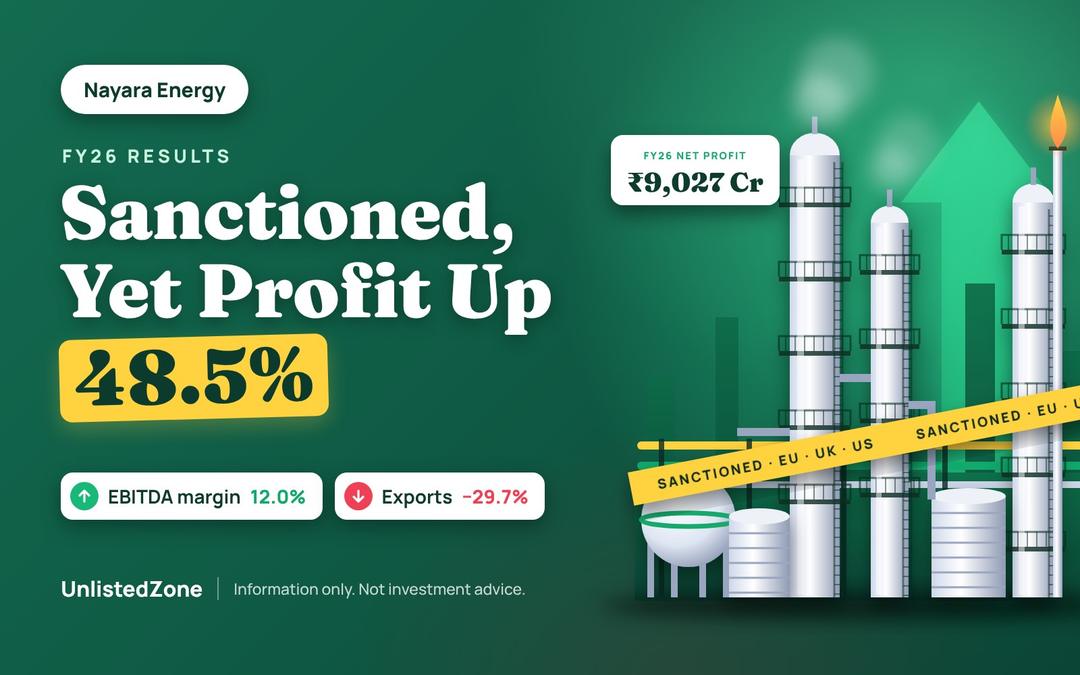
FY26 should have been a difficult year for Nayara Energy. Within months, the company faced sanctions from the European Union and the United Kingdom, and its largest shareholder was targeted by the United States. Some crude suppliers stepped back, and export markets became harder to reach.
Yet when the audited numbers came in, Nayara reported a net profit of ₹9,027 crore for the year ended March 2026. That is 48.5% higher than the ₹6,080 crore it earned a year earlier. Here is how that happened, and what the sanctions changed beneath the headline.
Nayara Energy, formerly Essar Oil, runs the 20 MMTPA refinery at Vadinar in Gujarat, India's second-largest single-site refinery. It also sells fuel through about 7,000 retail outlets, with roughly 1,800 more under development.
The company is owned in near-equal parts by two shareholders. Rosneft, Russia's state-backed oil major, holds 49.20%. Kesani Enterprises, the holding company of an investor consortium, holds another 49.20%. That Russian ownership is what brought Nayara into the sanctions net.
The pressure built steadily through the year:
July 2025: the European Union sanctioned Nayara.
October 2025: the United Kingdom followed.
November 2025: the United States sanctioned Rosneft, among other Russian producers.
April 2026: the EU sanctioned an entity that owns 49% of Kesani, Nayara's other major shareholder.
₹ crore | FY26 | FY25 | Change |
|---|---|---|---|
| Revenue from operations | 1,46,602 | 1,49,217 | −1.8% |
| Net revenue (after excise duty) | 1,23,439 | 1,28,620 | −4.0% |
| EBITDA (excl. other income) | 14,798 | 11,188 | +32.3% |
| EBITDA margin (on net revenue) | 12.0% | 8.7% | +330 bps |
| Net profit | 9,027 | 6,080 | +48.5% |
| EPS, basic (₹) | 60.64 | 40.79 | +48.7% |
The table makes one point clear. Revenue was flat to slightly lower, yet operating profit rose by about a third. The growth came from margins, not from volumes.
A refiner earns the difference between what it pays for crude and what it receives for petrol, diesel and other products. In FY26, that gap widened considerably for Nayara.
Its cost of raw materials fell 12.9%, from ₹98,039 crore to ₹85,353 crore, while sales held broadly steady. Gross margin, which is net revenue less crude, purchased products and inventory changes, rose about 26% to an estimated ₹23,224 crore.
Costs below that line grew far more slowly. Employee and other expenses rose by about ₹1,250 crore combined, and finance costs and depreciation were broadly flat. As a result, most of the margin gain flowed through to profit before tax, which rose 44% to ₹12,192 crore.
Nayara was not alone in this. Refining margins improved across the Indian industry in FY26; HPCL, for example, reported a gross refining margin of US$8.79 a barrel, up from US$5.74 (source). Nayara's crude basket also narrowed after some suppliers halted shipments, leaving it reliant mainly on Russian crude (source). The financial statements, however, do not quantify any cost advantage from this.
Crucially, the refinery kept running. Government data shows Vadinar processed 18.97 million tonnes of crude in FY26, around 95% of its capacity (source).
If the profit and loss statement suggests business as usual, the rest of the financial statements tell a different story. The sanctions left their mark in three places.
The first is the revenue mix. Export revenue fell 29.7%, from ₹36,993 crore to ₹25,991 crore, as overseas buyers became cautious. Nayara redirected product to the domestic market, where revenue rose 7.5% to ₹1,20,611 crore. India now accounts for 82% of its revenue, up from 75%.
The second is working capital. Trade receivables rose more than fourfold, from ₹4,213 crore to ₹18,827 crore. Trade payables more than tripled, from ₹7,112 crore to ₹23,154 crore, and inventories rose to ₹15,332 crore from ₹10,457 crore. Sanctions make banks wary of handling a company's payments, so money moves more slowly in both directions. This alone expanded the balance sheet by about a quarter, to ₹1,07,559 crore.
The third, and perhaps the most important, is debt. Nayara actually reduced its borrowings during the year, from ₹12,602 crore to ₹10,389 crore. But its loan agreements allow lenders to demand early repayment following the sanctions. The company has therefore shown all its borrowings as current liabilities, including loans not contractually due until after March 2027. Management notes that no lender has exercised this right and that the company has not missed any repayment.
The slower movement of money meant that cash generation lagged profit. Operating cash flow after tax was about ₹6,921 crore, well short of the ₹9,027 crore net profit.
That cash was put to three main uses. Nayara spent about ₹2,882 crore on capital projects, with capital work-in-progress rising to ₹4,890 crore as its petrochemicals expansion progressed. It repaid about ₹2,522 crore of loans and paid about ₹1,483 crore in finance costs.
Cash and cash equivalents fell to ₹987 crore from ₹2,157 crore, although bank deposits rose to ₹5,618 crore. Net debt stands at roughly ₹3,800 crore against shareholders' equity of ₹59,129 crore. The balance sheet is not stretched, but it is less comfortable than it was a year ago. No dividend was declared for the year.
Several risks sit behind the strong headline numbers:
Lender action. The right to accelerate loans has not been used, but it now exists.
Further sanctions. With both principal shareholders now linked to sanctioned entities, crude sourcing, export access and banking channels could tighten further.
A more cautious valuation. In its annual impairment test, Nayara valued its refining business at ₹82,709 crore, down from ₹93,527 crore a year earlier. This still exceeds the ₹59,501 crore carrying value, but the reduction reflects a more conservative view of the years ahead.
Normalising margins. Management's five-year plan assumes refining margins of US$6.6–10.0 per barrel from FY27 to FY31. FY26 conditions may not repeat.
Customer concentration. A single customer contributed ₹21,112 crore of revenue, including excise duty.
FY26 shows two sides of Nayara Energy. Operationally, the business held up well: the refinery ran close to capacity, the domestic market absorbed lost exports, and strong margins lifted profit sharply. Financially, the strain is visible in slower collections, higher working capital and loans that lenders can now recall.
FY27 will test which side prevails. The refinery entered a planned maintenance shutdown in April 2026, the latest round of EU sanctions has only just taken effect, and refining margins may moderate. If earnings hold and lenders remain supportive, FY26 may come to be seen as the year Nayara adapted to sanctions. If not, it may mark a high point.
This article is for information only and does not constitute investment advice. Unless a source link is given, figures are from Nayara Energy's audited consolidated financial statements for FY26. Gross margin is the author's estimate derived from those statements.
Nayara Energy Limited, audited consolidated financial statements for the year ended 31 March 2026 (auditor: S.R. Batliboi & Co. LLP)
Hydrocarbon Processing: Indian refiners' March crude processing (PPAC data)
Tank Terminals: Nayara says Vadinar refinery turnaround completed
ET via inkl: Nayara Energy completes scheduled Vadinar refinery turnaround