
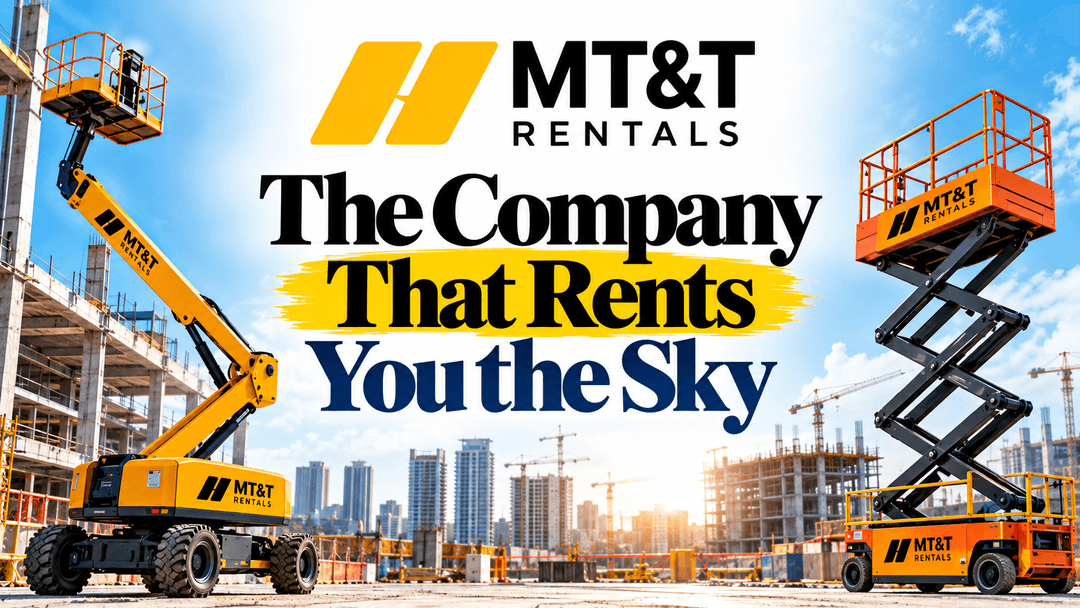
How MTandT Rentals turned scissor lifts into a ₹974 crore business
Picture a construction site on the Yamuna Expressway. There's a half-built warehouse, a 40-foot ceiling, and an electrician who needs to wire the lights up there.
Twenty years ago, he'd have climbed a rickety bamboo scaffold and hoped for the best. Today, he steps onto a platform, presses a button, and rises smoothly to the ceiling.
That machine is called a MEWP, a Mobile Elevating Work Platform. And there's a good chance the contractor didn't buy it. He rented it from a company called MTandT Rentals.
So let's talk about the business of renting the sky.
MTandT Rentals started in Chennai in 2009. The idea was simple: big machines that lift people safely are expensive, and most project owners need one for months, not forever. So why not own a fleet and rent it out?
Seventeen years later, here's where things stand:
Fleet worth about ₹585 Cr at cost, mostly imported scissor and boom lifts
Yards across India: Chennai, Noida, Jewar, Mumbai, Ahmedabad, Bengaluru and Bhubaneswar
1,230 employees
About ₹120 Cr raised this year from investors including ValueQuest
FY26 was the year it shifted gears.
Think of MTandT like a car rental company for heavy machinery, with a showroom attached. It has three money engines.
Engine 1: Renting. Machines go out to project sites, and customers sign monthly log sheets showing how long each machine worked. MTandT bills on those sheets. This is the steady, recurring income.
Engine 2: Trading. Some customers would rather own. So MTandT also sells new equipment, ground-protection mats (Porta Deck) and spares. This income is lumpier but has been growing fast.
Engine 3: Recycling. After a few years, rental machines are sold off. Because they're depreciated quickly in the books, they often sell for more than their book value. That gap shows up as profit.
Here's how the engines performed (standalone, ₹ Cr):
| Engine | FY26 | FY25 | Growth |
|---|---|---|---|
| Rental | 169.07 | 118.78 | +42% |
| Equipment sales | 163.69 | 89.27 | +83% |
| Mats, spares & others | 25.93 | 9.29 | +179% |
| Revenue from operations | 358.69 | 217.35 | +65% |
| Profit on used-fleet sales | 15.19 | 6.49 | +134% |
The plot twist is that trading (equipment, mats and spares together) overtook rental this year. MTandT is becoming as much a dealer as a rental company.
Here's the thing about rental businesses: to grow, you must first spend.
Every new lift MTandT buys sits on its balance sheet and gets paid for with bank loans secured against the machine itself. Then it has to earn its keep through rent. In FY26:
It spent ₹250 Cr on new equipment
It added about ₹142 Cr of fresh borrowings
Depreciation and interest together took about a quarter of revenue
It's a treadmill. The faster you want to grow, the faster you have to buy. And rental income grew 42% while the fleet grew about 46%, so most of the growth came from more machines, not better pricing.
| Metric | FY26 | FY25 | Change |
|---|---|---|---|
| Revenue | 366.67 | 224.45 | +63% |
| Operating EBITDA | 130.66 | 84.91 | +54% |
| EBITDA margin | 35.6% | 37.8% | ↓ |
| Net profit | 52.64 | 30.44 | +73% |
| Net worth | 323.62 | 154.49 | +109% |
| Total debt | 338.90 | 197.33 | +72% |
| Debt / Equity | 1.05x | 1.28x | ↓ Better |
| Cash from operations | 50.83 | 19.53 | +160% |
Profits are booming and leverage is falling, thanks to the fresh equity. That much is good news.
Every good story has a twist, and this one has a few.
Customers are paying slowly. Receivables doubled to about ₹189 Cr. That's roughly six months of revenue waiting to be collected, and ₹5.7 Cr has already been set aside as doubtful.
Cash is going out faster than it comes in. Free cash flow was about –₹166 Cr. Growth is being funded by lenders and investors, not by the business itself.
Part of the profit is one-off. About 22% of pre-tax profit came from selling old machines.
Dollars can bite. Roughly ₹270 Cr of payables are in foreign currency, and the company booked a ₹3.8 Cr forex loss this year.
The family ties run deep. There are sizeable transactions with promoter group companies, including a ₹26 Cr royalty deposit with Mtandt Limited.
MTandT is unlisted, but its shares trade on platforms like ours, UnlistedZone, at about ₹545.
| Metric | Value |
|---|---|
| Market cap | ₹974 Cr |
| Enterprise value | ₹1,240 Cr |
| P/E | 18.5x |
| P/B | 3.0x |
| EV / EBITDA | 9.5x |
| ROE (average equity) | 22% |
| Last funding round | ₹459/share (≈ ₹820 Cr) |
Two things stand out:
You'd be paying about 19% more than what institutional investors paid just six months ago.
The stock is sitting at its 52-week low, down from ₹660.
There's also a quieter risk. The preference shares issued this year can convert into more equity shares if performance targets aren't met. That would mean more slices of the same pie, so each slice gets smaller.
India is building at a pace it never has before, and almost every new building has a high ceiling that someone has to reach.
Big projects everywhere. Metros, airports, factories, data centres and giant warehouses all need a lot of work done at height.
Safety is finally catching up. Global companies building in India bring their own safety rules, and bamboo scaffolding doesn't pass them. IPAF credits India's 2025 growth to rising workplace safety awareness and fleet expansion.
Speed matters. A lift goes up in seconds. A scaffold takes days to build and take down. As labour gets costlier and deadlines tighter, machines win.
Renting beats buying. A contractor needs a lift for six months, not ten years. Renting keeps his money free for the project itself.
The numbers back this up. In 2024, India's MEWP rental market grew 32% on a 24% bigger fleet. In 2025 it grew another 18%, with the fleet up 14% and utilisation higher.
| Country | MEWPs (approx.) |
|---|---|
| USA (rental fleet only, 2025) | ~8.75 lakh |
| China (2022) | ~5 lakh |
| India (industry estimate) | ~20,000 |
The US rental fleet alone reached about 875,000 units in 2025. China's jump was even more dramatic: from around 40,000 units in 2017 to nearly 500,000 by 2022.
India is so far behind for four simple reasons:
Labour is cheap, scaffolding is cheaper. For decades, a few workers and some bamboo cost less than renting a machine. That gap is now closing.
Safety rules exist but are loosely enforced. In the US and Europe, working at height without proper equipment can shut a site down. In India, that pressure is only now arriving.
Almost no machines are made here. China built its own industry with dozens of local manufacturers, so machines became cheap. India mostly imports, which means higher prices plus currency risk (remember MTandT's ₹270 Cr of foreign-currency payables).
Every machine needs a person. In India, aerial platforms are usually supplied with an operator. That adds cost and slows how fast fleets can scale.
The gap is the opportunity. Even if India reaches a fraction of China's numbers, the fleet has to multiply several times over.
But China is also a warning. It grew too fast, and in 2025 its leading rental companies were shrinking fleets, halting new purchases and selling off assets. Too many machines chasing too few jobs crushes rental rates. Indian players need to grow with discipline.
If you want to see where this business can go, look at the US. United Rentals (NYSE: URI) is the world's largest equipment rental company and has been listed since 1997.
How big is it? United Rentals earned $16.1 billion in revenue in 2025. That's roughly ₹1.4 lakh crore, or about 400 times MTandT's revenue. Its market value is about $68.6 billion, roughly ₹6 lakh crore.
Revenue growth, last three years (US$ bn)
| Year | Revenue | Growth |
|---|---|---|
| 2025 | 16.10 | +5% |
| 2024 | 15.35 | +7% |
| 2023 | 14.33 | +23% |
| 2022 | 11.64 | — |
The 2023 jump came mostly from acquiring Ahern Rentals. Without deals, URI is now a mid-single-digit grower. For 2026, it has raised its revenue outlook to $17.5–17.8 billion, which implies about 9–10% growth.
What the market pays for it
| Metric | United Rentals | MTandT |
|---|---|---|
| Revenue growth (latest year) | ~5% | ~63% |
| EBITDA margin | ~46% | ~36% |
| P/E | ~26x | 18.5x |
| EV / EBITDA | ~10x | 9.5x |
| Free cash flow | +$2.2 bn | –₹166 Cr |
The interesting part: MTandT trades at almost the same EV/EBITDA as United Rentals while growing more than ten times faster. On that view it looks cheap.
But URI earns its multiple differently. In 2025 its operating cash flow rose 14% to $5.19 billion, free cash flow reached $2.18 billion, and it returned $2.36 billion to shareholders through buybacks and dividends. MTandT is still burning cash to grow.
US investors pay for a machine that prints cash. Indian investors are paying for one that's still being built. If MTandT can turn its growth into positive free cash flow and faster collections, the valuation gap could close in its favour.
MTandT Rentals is riding a real wave. India is building warehouses, metros, factories and airports, and safety rules are getting stricter. India has a tiny fraction of the machines the US and China run, so the runway is long. Someone has to lift those workers, and MTandT wants to be that someone. Management is aiming for 25%+ growth every year for a decade.
The valuation of about 18.5x earnings isn't outrageous for that kind of growth, and on EV/EBITDA it sits level with United Rentals, a far slower grower. But it's a capital-hungry business with slow collections, negative free cash flow, and an exit that depends on a future IPO.
In short, the business is rising. Whether investors rise with it depends on collections, cash flow and whether that IPO actually arrives.
Keep an eye on: FY27 receivables, the CCPS conversion outcome, and any IPO announcement.
MTandT Rentals Annual Report FY 2025–26; share price from UnlistedZone as of 10 October 2026
This is not investment advice. Unlisted shares are illiquid and risky, so do your own research. US valuation figures are as of early October 2026 and change daily. India's fleet figure is an industry estimate.