
Motilal Oswal Home Finance: Growing fast, but who's paying the bill?
In today's story, we break down Motilal Oswal Home Finance's H1 FY27 results: what went right, what's quietly creeping up, and what it all means if you're tracking this unlisted name.
Imagine you run a small neighbourhood lending shop. Families walk in wanting to buy their first home: a 1BHK on the edge of the city, a plot where they'll build slowly, floor by floor. Banks often don't want them. Their income might be in cash, their paperwork thin. You step in.
That's roughly the world of Motilal Oswal Home Finance (MOHFL). It's a housing finance company (HFC), part of the Motilal Oswal group, that mostly lends to lower- and middle-income families in smaller towns, a space usually called affordable housing finance.
And on 28 October 2026, MOHFL told us how its first half of FY27 (April–September 2026) went.
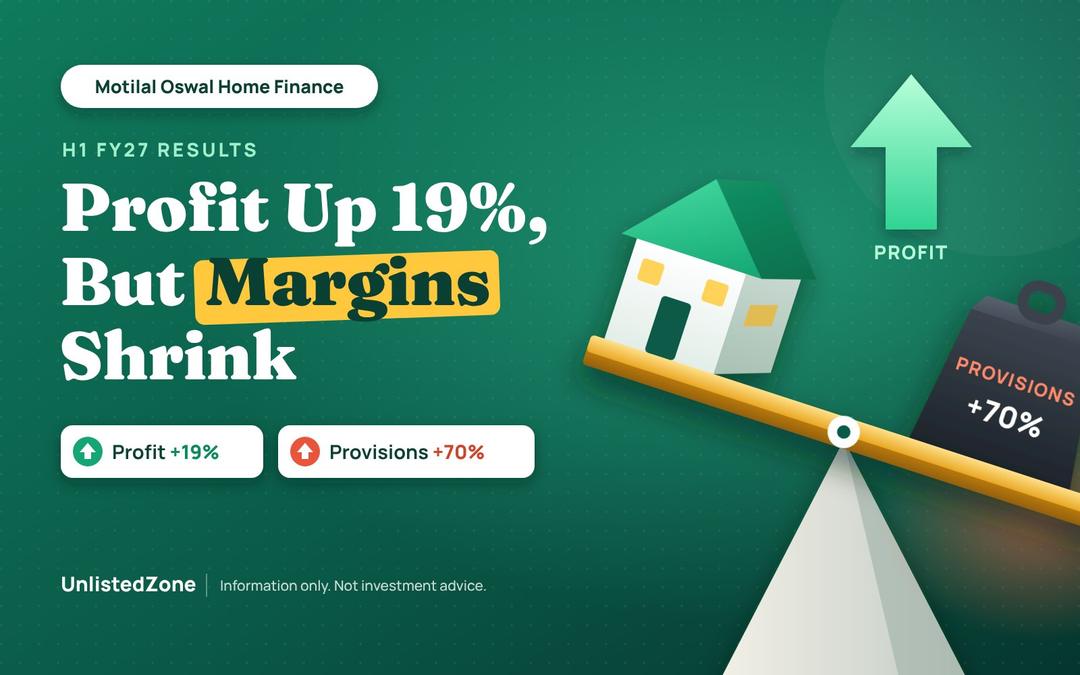
The short version? Profit is up 19%. The longer version is more interesting.
All figures in ₹ crore unless stated. H1 = six months to 30 September. NIM uses average loan book of ₹5,954 cr (H1 FY27) and ₹4,560 cr (H1 FY26).
Metric | H1 FY27 | H1 FY26 | Change |
|---|---|---|---|
| Total income | 452.2 | 368.6 | +23% |
| Interest income | 407.9 | 347.7 | +17% |
| Finance cost (interest it pays) | 189.9 | 158.4 | +20% |
| Net interest income (NII) | 217.9 | 189.3 | +15% |
| NIM (NII ÷ avg loan book, annualised) | 7.32% | 8.30% | −98 bps |
| Fee & commission income | 29.2 | 11.5 | +153% |
| Gain on selling loans (assignment) | 14.9 | 8.8 | +69% |
| Operating expenses | 144.3 | 119.6 | +21% |
| Provisions for bad loans | 29.1 | 17.1 | +70% |
| Profit before tax | 88.9 | 73.4 | +21% |
| Net profit | 68.9 | 57.9 | +19% |
At first glance it all looks good: income up, profit up. But look closer and some rows are growing faster than others. That's where the story is.
A lender's loan book is its factory. The bigger it is, the more interest it earns.
31 Mar 2026 | 30 Sep 2026 | Growth | |
|---|---|---|---|
| Loan book | ₹5,580 cr | ₹6,328 cr | +13% in 6 months |
That's about 27% annualised, which is quick for a home lender. The cash flow statement shows the same thing: the net increase in loans was ₹763 cr this half, against just ₹317 cr in the same half last year. MOHFL has clearly put its foot on the accelerator.
Lenders don't only earn interest. They also charge processing fees, insurance commissions and so on. MOHFL's fee income jumped from ₹11.5 cr to ₹29.2 cr.
On top of that, it made ₹14.9 cr by selling some loans to other lenders (called direct assignment). Think of it like baking a cake and selling a slice to a neighbour. You get cash upfront, and you free up capital to bake more cakes. This half, MOHFL sold 842 loans worth ₹113 cr, keeping a 10% share in them.
This is the big one for any lender.
Sep 2026 | Sep 2025 | |
|---|---|---|
| Gross NPA | 1.52% | 1.56% |
| Net NPA | 0.91% | 0.92% |
Quick explainer: A loan becomes a non-performing asset (NPA) when the borrower stops paying for 90+ days. Gross NPA is the full pile of such loans. Net NPA is what's left after subtracting the money already set aside to cover losses.
Here's why this matters. When a lender grows fast, it often loosens its standards, and bad loans pile up a year or two later. So far, MOHFL's NPAs have actually dipped while the book grew. In rupees, that's roughly ₹96 cr gross and ₹58 cr net (our estimate).
Operating expenses grew 21%, slightly slower than total operating income. So MOHFL now spends roughly ₹55 to earn ₹100, down from ~₹57 a year ago (our estimate). Small, but in the right direction.
Lenders set aside money every quarter for loans that might go bad. These are called provisions or impairment. This half, that number rose from ₹17 cr to ₹29 cr.
Zoom into just Q2 and it's sharper:
Q2 FY27 | Q2 FY26 | Change | |
|---|---|---|---|
| Provisions | ₹13.8 cr | ₹6.1 cr | +125% |
| Net profit | ₹36.5 cr | ₹34.0 cr | +7% |
So while the half-year profit grew 19%, Q2 profit grew only 7% year-on-year. Rising provisions ate most of the gain.
To be fair, part of this comes from a low base. In the second half of FY26, MOHFL actually wrote back some provisions, so last year looked unusually clean. Some of this increase is also simply because the book is bigger. Still, it's the number to watch next quarter.
Here's a subtle one.
Interest earned: +17%
Interest paid on borrowings: +20%
So NII (the difference): +15%
Meanwhile, total income grew 23%. The gap is filled by fees and loan-sale gains, which can be lumpy. You can't sell loans every quarter at a profit, and fee spikes don't always repeat.
Share of revenue from fees + loan sales | |
|---|---|
| H1 FY26 | 5.5% |
| H1 FY27 | 9.8% |
Not a red flag, but it means a slightly bigger slice of profit now depends on things other than plain lending.
To fund all this growth, MOHFL borrowed more and spent down its cash.
Metric | Earlier | Now |
|---|---|---|
| Debt-to-equity | 2.57x | 2.92x |
| Debt as % of total assets | 68% | 73% |
| Capital adequacy (CRAR) | 42.5% | 34.9% |
| Liquidity coverage ratio | 200% | 158% |
| Cash + liquid investments | ~₹586 cr (Mar) | ~₹235 cr |
Quick explainer: Capital adequacy (CRAR) is the cushion of the lender's own money that absorbs losses. The RBI requires HFCs to keep at least 15%. Liquidity coverage measures whether it has enough liquid assets to survive a short-term cash crunch. The requirement is 100%.
So all of these are still comfortably above the regulatory minimums. In fact, MOHFL was arguably over-capitalised, sitting on more capital than it needed. Using some of it to grow is reasonable. But the direction is clear: the cushion is getting thinner as the company grows.
Because MOHFL sits on so much capital, its return on equity is only ~8.4% (annualised, our estimate). That's low for a lender. Return on assets is healthy at ~2.1%.
Put simply, the business is profitable on what it lends, but there's a lot of idle shareholder money that isn't earning much yet. Faster growth and more leverage are, in a way, the fix for this. That makes point 3 a trade-off rather than just a risk.
MOHFL still carries loans it restructured during COVID.
Restructured book | ₹ crore |
|---|---|
| Start of half | 150.8 |
| Slipped into NPA this half | 6.5 |
| Written off | 1.9 |
| Repaid by borrowers | 8.5 |
| End of half | 133.9 |
It's shrinking, which is good. But about 4% of it turned bad in just six months, a reminder that this part of the book is fragile.
Here's how we'd sum it up:
👍 The good | 👀 The watch-list |
|---|---|
| Profit up 19% in H1 | Q2 profit up only 7% |
| Average loan book up 31% | NIM down to 7.32% from 8.30% |
| Loan book up 13% in six months | Provisions up 70% |
| Fee income more than doubled | More profit from lumpy fees and loan sales |
| NPAs steady at 1.52% / 0.91% | Debt-to-equity up to 2.92x |
| Still well above regulatory capital and liquidity norms | ROE still only ~8% |
MOHFL is clearly in growth mode. It's lending faster, earning more fees and putting its spare capital to work. And so far, the loan quality is holding up. That's the encouraging part.
But growth in lending always comes with a delayed bill. Bad loans usually show up a year or two after the loans are made. The jump in Q2 provisions could just be the cost of a bigger book, or it could be the first sign of that bill arriving.
The next two quarters will tell us which one it is. If provisions settle down while the book keeps growing, MOHFL's story gets a lot stronger. If they keep climbing, the 19% profit growth will start to look less impressive.
Until then...
Source: Motilal Oswal Home Finance unaudited financial results for the quarter and half year ended 30 September 2026 (filed 28 October 2026). NII, NIM, cost-to-income, ROE/ROA, annualised growth and rupee NPA figures are our own calculations from the filing. Loan growth is measured against 31 March 2026, as the filing doesn't give the September 2025 loan book. The H1 FY26 average loan book (₹4,560 cr) is not from this filing.
This is not investment advice.