
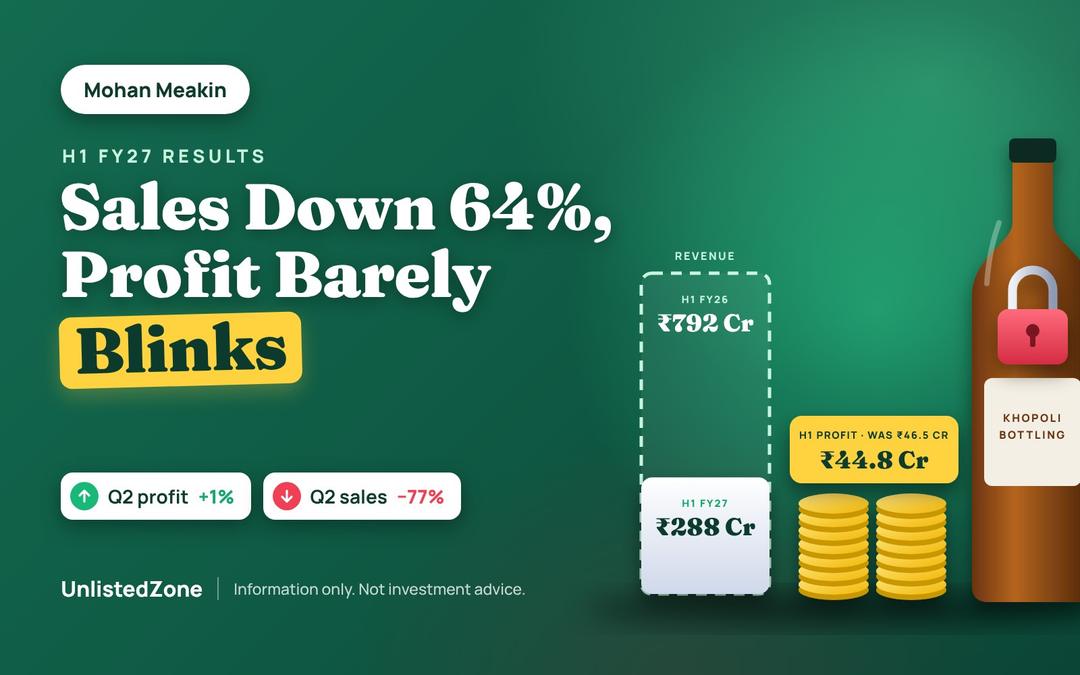
In short: Mohan Meakin's revenue fell 64% in H1 FY27 (Apr–Sep 2026), from ₹792 crore to ₹288 crore. Its net profit barely moved: ₹44.8 crore, against ₹46.5 crore a year ago. The two numbers are connected, and the connection runs through a shut bottling plant in Khopoli, Maharashtra, and the Old Monk ban.
Picture this. You open a company's results and see that revenue has fallen off a cliff. Q2 sales are down 77%. Your first thought is that something has gone badly wrong.
Then you scroll down to profit, and it is up 1% for the quarter.
That should not happen. Companies that lose three-quarters of their sales usually lose money too. So either Mohan Meakin has found a magic trick, or the revenue it lost was never making it much money in the first place.
It is the second one. To see why, you first need to know something odd about the company behind Old Monk: in many states it doesn't actually make Old Monk. It buys the bottles from someone else and resells them.
Let's unpack that.
Revenue fell sharply in both quarters of H1 FY27 (Apr–Sep 2026), but profit before tax hardly moved. All figures are standalone, unaudited, in ₹ crore.
Metric (₹ cr) | Q2 FY27 | Q2 FY26 | YoY | H1 FY27 | H1 FY26 | YoY |
|---|---|---|---|---|---|---|
| Revenue from operations | 107.9 | 472.8 | −77% | 287.8 | 792.2 | −64% |
| Net revenue (after excise) | 94.1 | 456.8 | −79% | 264.5 | 764.6 | −65% |
| Purchases of stock-in-trade | 3.3 | 354.6 | −99% | 84.4 | 557.8 | −85% |
| EBITDA (excl. other income) | 26.7 | 29.5 | −9% | 48.3 | 54.1 | −11% |
| Other income | 10.2 | 5.9 | +73% | 19.4 | 11.5 | +69% |
| Profit before tax | 33.8 | 32.7 | +4% | 61.5 | 62.3 | −1% |
| Net profit | 24.6 | 24.3 | +1% | 44.8 | 46.5 | −4% |
| EPS (₹) | 28.89 | 28.58 | +1% | 52.67 | 54.64 | −4% |
H1 FY26 profit included a one-off ₹2.1 crore gain from selling land at Kalka. Strip that out and H1 profit before tax was essentially flat. EBITDA here is profit before tax plus finance costs and depreciation, minus other income.
The row to watch is "purchases of stock-in-trade". It went from ₹355 crore in Q2 FY26 to ₹3.3 crore in Q2 FY27. Hold that thought.
Old Monk is sold in states across India, but Mohan Meakin has only four working plants: Solan, Kasauli, Bhankarpur and Mohan Nagar. Liquor is regulated state by state, and states charge heavy fees on liquor made elsewhere. So shipping rum from Himachal to every corner of the country doesn't make sense.
The company gets around this in three ways (UnlistedZone FY26 analysis):
It makes the rum itself. Mohan Meakin brews and bottles in its own plants, pays the excise duty and books the full sale.
It buys from a local bottler and resells. A bottler makes Old Monk under licence inside a state. Mohan Meakin buys the finished bottles and sells them on. This shows up as "purchases of stock-in-trade".
It collects a royalty. Where the bottler sells directly, Mohan Meakin earns a fee on every case.
The second route is the big one for revenue. In FY26, traded goods made up about ₹1,520 crore of Mohan Meakin's ₹2,302 crore revenue, or roughly two-thirds. But Mohan Meakin paid about ₹1,493 crore for those bottles. That leaves a spread of about ₹26 crore, or under 2%.
In other words, trading makes the revenue line look big but adds little to profit.
The most important of these bottlers is Mohan Rocky Springwater Breweries (MRSB). It is a related party with a plant in Khopoli, Maharashtra. It bottles only for Mohan Meakin and supplies Maharashtra, Gujarat and the military canteens (CSD).
Revenue fell because the Old Monk pipeline from Khopoli dried up. The filing doesn't name the cause, but the dates and numbers match.
May 2026: Mohan Rocky Springwater's Khopoli plant, Mohan Meakin's main bottler, stopped operating.
Aug 2026: FSSAI barred three Khopoli-made Old Monk variants over added flavouring and a misleading "7 Years Old" claim.
Nov 2026: The bottler withdrew its court case and is resubmitting labels to FSSAI. The ban stays until they are approved.
What Mohan Meakin bought from bottlers fell from ₹355 crore in Q2 FY26 to just ₹3.3 crore in Q2 FY27. That explains about ₹351 crore of the ₹365 crore fall in Q2 revenue.
The ban covers only Khopoli-made Old Monk, not all Old Monk. But Khopoli also supplies Gujarat and the military canteens, so the hit goes beyond Maharashtra.
This is not a nationwide ban. Only Khopoli-made Old Monk was barred. Old Monk from other plants is still on shelves elsewhere.
The hit is wider than Maharashtra. MRSB also supplies Gujarat and the military canteens, so those channels likely suffered too.
Own manufacturing slipped as well, but only a little. Raw material use fell 33% in Q2 and excise paid fell 14%. Inventory rose by ₹28 crore in H1, so some stock is waiting to be sold. That part of the slowdown can't be tied to Khopoli from the filing alone.
Profit held because the revenue that vanished earned a spread of under 2%, while the rest of the business kept earning. Think of it like a shopkeeper who stops reselling a supplier's goods at near cost. The till looks emptier, but the earnings barely change.
Three things kept the bottom line steady:
The core business still works. The alcoholic segment earned ₹33.5 crore in Q2 FY27 before interest and tax, down only 8% from ₹36.3 crore. That's against a 78% fall in the segment's revenue.
Margins look far better on paper. EBITDA was 28% of net revenue in Q2 FY27, up from 6% a year ago. The business didn't get more efficient. The low-margin trading revenue simply left the denominator.
The cash pile helped. Other income rose 73% to ₹10.2 crore in Q2, mostly interest. Mohan Meakin holds about ₹429 crore in cash, bank deposits and investments, against borrowings of just ₹4.3 crore.
The revenue will likely come back when Khopoli restarts, and that depends on FSSAI approving the new Old Monk labels. Until then, expect the top line to stay low and profit to hold roughly steady.
Here's what to watch:
FSSAI's decision on the revised labels. MRSB has dropped its court fight and gone back to the regulator. The labels have reportedly been rejected twice before.
Whether trading purchases restart in Q3 FY27 (Oct–Dec). That will be the first sign Khopoli is back.
The non-Khopoli business. If own manufacturing keeps slipping after Khopoli reopens, the problem is bigger than one plant.
Rival rums. Every month Old Monk is missing from Maharashtra shelves, rival brands get a chance to win over its drinkers.
The bigger lesson is about reading results. A 77% revenue fall sounds like a disaster. Here it mostly means a middleman pipe was switched off. For a business like Mohan Meakin, profit and the reason behind each revenue line matter more than the headline number.
This article is for information only and isn't investment advice.
Mohan Meakin Ltd, unaudited standalone results for the quarter and half year ended 30 September 2026 (board meeting of 13 November 2026),
UnlistedZone: Mohan Meakin FY26, the Old Monk business decoded
Business Standard: Old Monk sales ban costs Maharashtra ₹350 cr, company loses ₹500 cr
Free Press Journal: Old Monk maker withdraws plea challenging FSSAI ban
Free Press Journal: Bombay HC refuses immediate stay on Old Monk sales ban