
Would you want to be the first patient a young surgeon ever operates on? Probably not. That's the problem Maverick Simulation Solutions is trying to solve.
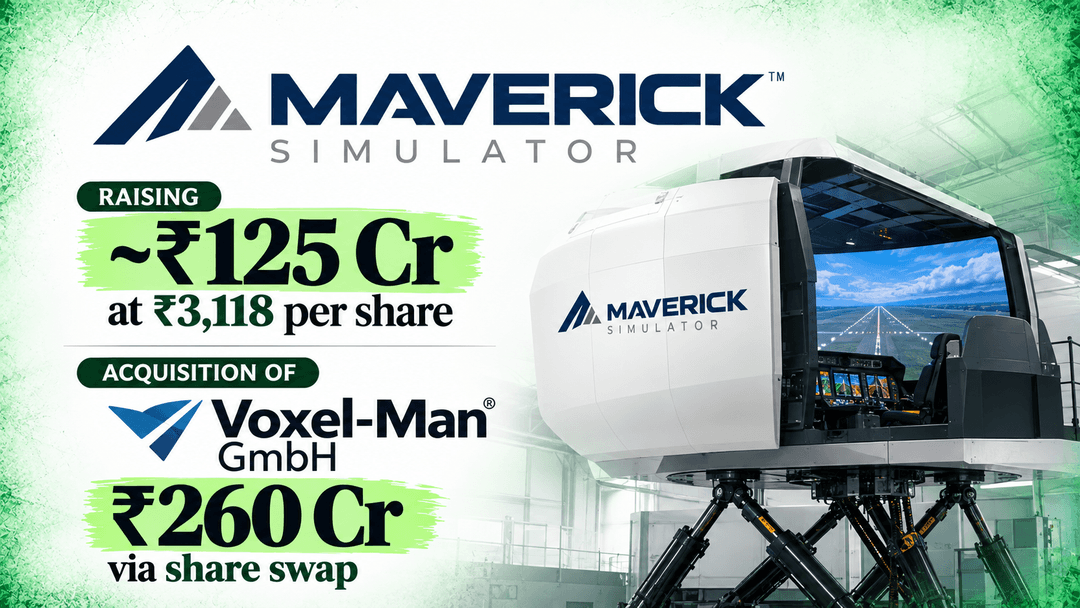
This week, its shareholders vote on two big things: a ₹125 crore fundraise, and a ₹260 crore deal to buy a European surgical simulator company, paid fully in shares. Let's break it down.
Maverick makes medical dummies. Very smart ones.
These are life-size mannequins that breathe, have a pulse and can "crash" on cue. Doctors and nurses use them to practise CPR, injections and emergencies without risking a real patient. Maverick sells them to over 100 colleges and hospitals, including AIIMS and the IITs, and sets up complete simulation labs.
It has grown very fast. Revenue jumped from ₹14 crore in FY24 to ₹136 crore in FY25, with a profit of about ₹48 crore. But most of that money hadn't come in yet: customers owed Maverick about ₹105 crore at year-end. That's one big reason it needs fresh cash.
Maverick is raising ₹125.5 crore at ₹3,118 per share. Investors get compulsorily convertible preference shares (CCPS). These turn into normal shares later and give investors some extra protection if things go wrong.
The money is meant for growth, new products and acquisitions. The same meeting also converts founder Anuj Chahal's ₹13 crore loan into shares, and asks permission to borrow up to ₹800 crore.
Investor | Who they are | Amount (₹ crore) | Stake after deal |
|---|---|---|---|
| Paragon Partners Growth Fund II | Mumbai private equity fund started by Siddharth Parekh, son of Deepak Parekh | 75.0 | 3.90% |
| VantEdge Partners LLP | Delhi-based company, little public information | 38.5 | 2.00% |
| Inviga Healthcare Fund I | Bengaluru healthcare fund started by HCG founder Dr B.S. Ajaikumar | 12.0 | 0.62% |
Paragon is clearly the lead investor. A doctor-backed fund like Inviga joining in also makes sense for a medical training company.
Maverick is also buying Voxel-Man GmbH, a Swiss company, for ₹260 crore. No cash is paid. Instead, Maverick gives new shares to Voxel-Man's owner.
And who's the owner? Voxel-Man is 100% owned by Anuj Chahal, Maverick's promoter and founder. He is also a director of Maverick and signed this EGM notice. So he is selling a company he fully owns to the company he runs, and getting paid in more of its shares. That's why this is put to shareholders as a related party transaction.
It happens in two steps. First Maverick buys 2% of Voxel-Man for ₹5.2 crore. Then it buys the remaining 98% for ₹254.8 crore, by October 2027.
There's one twist. The new investors are protected: if Maverick issues shares for Voxel-Man, their stake gets topped up so they don't lose any percentage. Other existing shareholders don't get this protection.
Voxel-Man started around 1984 as a research project at a big university hospital in Hamburg, Germany. Today it makes virtual surgery simulators for ear, sinus and dental surgery, and for ultrasound. The trainee operates on a 3D patient on screen using a robotic pen that pushes back, so the drill actually feels real. Universities around the world use its machines.
The fit is simple. Maverick makes physical dummies cheaply in India. Voxel-Man brings high-end virtual surgery tech and a global brand. Together, Maverick can sell a more complete lab, and Voxel-Man gets access to India's fast-growing medical colleges.
To value Maverick, first we need to count its shares. Then we multiply by the ₹3,118 price the new investors are paying.
Type | Number |
|---|---|
| Equity shares | 49,13,851 |
| Series A CCPS | 3,53,658 |
| ESOP pool (for employees) | 1,42,720 |
| Total on a fully diluted basis, as per the notice | 57,27,952 |
The Series A CCPS were issued to promoters and insiders at ₹1,640 each. Item 8 of this EGM changes their conversion ratio from 1:1 to 1:1.45, so they will turn into about 5.13 lakh equity shares instead of 3.54 lakh. The notice doesn't show exactly how it arrives at 57,27,952, so treat the split above as approximate.
Step | Shares added | Total shares | Promoter % | Value at ₹3,118 |
|---|---|---|---|---|
| Before EGM | – | 57,27,952 | 69.45% | ~₹1,786 crore |
| Loan conversion | 41,853 | 57,69,805 | 69.67% | ~₹1,799 crore |
| Series B fundraise | 4,02,496 | 61,72,291* | 65.13% | ~₹1,925 crore |
| Voxel-Man tranche 1 (2%) | 16,677 | 61,88,968 | 65.22% | ~₹1,930 crore |
| Voxel-Man tranche 2 (98%) | 8,17,190 | 70,06,158 | 69.28% | ~₹2,185 crore |
So the share count grows by about 12.8 lakh, or 22%. The promoter's stake dips after the fundraise, then climbs back to about 69% after the Voxel-Man deal.
*The notice's total leaves out Paragon's 10 equity shares. Also, these numbers ignore the Series B top-up clause. In reality, the Series B investors would get extra shares after the Voxel-Man deal to stay near 6.5%.
What | Value | What it means |
|---|---|---|
| Series B price | ₹3,118 per share | About 40x FY25 profit on ~₹1,925 crore |
| Unlisted market price (Aug–Sep 2026) | ~₹2,320–2,375 per share | The Series B price is about 31–34% higher |
| Voxel-Man | ₹260 crore (~$30 million) | Its revenue is not disclosed |
| Simbionix, bought by Surgical Science (2021) | $305 million | About 7.4x its revenue |
| CAE Healthcare, sold to Madison Industries (2023) | $227 million | A global leader in patient simulators |
In short, the new investors are paying a clear premium to the unlisted market price. And after the fundraise, Maverick is priced close to what a global leader like CAE Healthcare sold for.
More medical colleges. India had 816 medical colleges and about 1.37 lakh MBBS seats in 2025-26, and the government has promised 75,000 more seats over five years. Every new college is a new customer.
Skills labs are compulsory. The regulator, NMC, requires every medical college to have a skills lab with mannequins and trainers. So demand is built into the rules.
Safer training. Practising on real patients and human bodies is getting harder. A simulator can be used again and again, with nobody at risk.
Make in India. Most high-end simulators are imported and expensive, so cheaper local ones have a big opening. Globally, the market is worth about $3.5 billion and growing around 15% a year.
Not really. There's no pure medical simulation stock in the US. Big players like Laerdal and Gaumard are private. The closest options:
Company | Listed on | Link to simulation |
|---|---|---|
| Surgical Science | Stockholm | Closest pure-play: VR surgery simulators |
| Intuitive Surgical | NASDAQ (ISRG) | Sells simulators for its da Vinci surgical robots |
| VirTra | NASDAQ (VTSI) | Makes simulators, but for police and military training |
| CAE | NYSE (CAE) | Flight simulator giant; sold its healthcare arm in 2023 |
Maverick is in a good sector with real demand. But in one meeting, the founder converts his loan, sells his own company to Maverick for ₹260 crore in shares, and ends up owning about 68%. The new investors are protected from dilution; other shareholders aren't.
Before voting, shareholders should ask for two things: the valuation report, Voxel-Man's revenue and profit.
This is an explainer, not investment advice.