
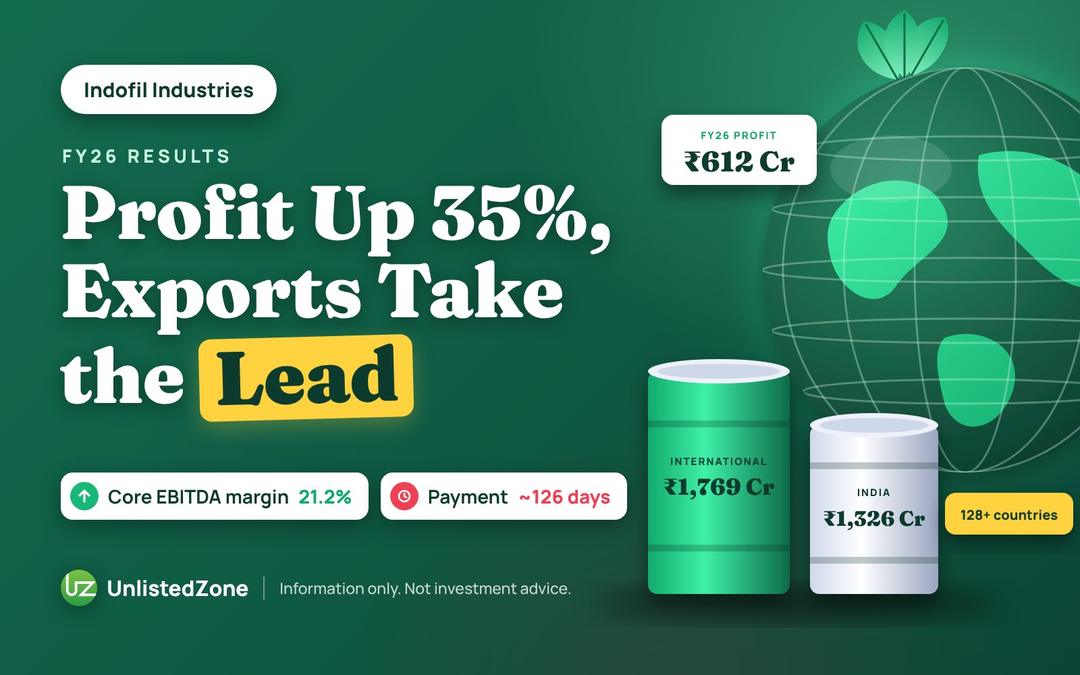
₹3,586 crore in revenue. ₹612 crore in net profit. Almost no debt. And an unlisted share price of ₹1,725 that values the entire company at ₹3,904 crore, or just 6.4 times earnings.
For context, Indofil's closest listed peers, Rallis India and Dhanuka Agritech, trade at 14–18 times earnings while earning a third to half of Indofil's profit. This article examines Indofil's FY26 performance, the quality of those earnings, and the single balance-sheet item that explains most of the valuation gap: a stake in Godfrey Phillips India.
Metric | Value |
|---|---|
| Unlisted share price (27 Nov 2026, indicative) | ₹1,725 |
| Market capitalisation | ₹3,904 cr |
| Revenue from operations (FY26) | ₹3,586 cr |
| EBITDA (reported / core) | ₹944 cr / ₹761 cr |
| Profit after tax | ₹612 cr |
| EPS | ₹269 |
| P/E · P/B | 6.4x · 0.6x |
| Net cash | ~₹880 cr |
| Value of Godfrey Phillips stake | ~₹3,505 cr |
Indofil Industries is part of the KK Modi group, the promoter group behind Godfrey Phillips India. It began manufacturing Mancozeb, a broad-spectrum fungicide, in 1962. Today it is one of the largest Mancozeb producers globally, alongside UPL and Coromandel International.
Manufacturing: three units at Dahej SEZ, Gujarat, covering both the technical-grade chemical and finished formulations
R&D: a centre in Thane with 57 scientists; 17 patents filed in FY26
Reach: products sold in more than 128 countries
Registrations: 586 active international product registrations
Indofil operates two businesses. Agrochemicals covers fungicides, insecticides, herbicides and plant nutrition, sold to farmers in India and to distributors overseas. Indofil Innovative Solutions (IIS) supplies emulsion polymers and specialty chemicals to the coatings, plastics, textile and leather industries.
Segment (FY26) | Revenue | Share of revenue | Segment result | Margin |
|---|---|---|---|---|
| Agrochemicals | ₹3,095 cr | 86% | ₹826 cr | ~27% |
| Innovative Solutions | ₹491 cr | 14% | ₹82 cr | ~17% |
Exports now exceed domestic sales. Agrochemical revenue split into ₹1,769 crore from international markets and ₹1,326 crore from India.
The company's main competitive advantage overseas is regulatory. A pesticide can only be sold in a country after that specific product is registered there, which typically takes several years. Indofil added about 60 registrations in FY26, 25 of them in Europe.
In FY26 (April 2025–March 2026), profit grew roughly three times faster than revenue.
Metric (consolidated) | FY25 | FY26 | Change |
|---|---|---|---|
| Total income | ₹3,419 cr | ₹3,816 cr | +12% |
| EBITDA | ₹636 cr | ₹944 cr | +48% |
| Profit after tax | ₹452 cr | ₹612 cr | +35% |
| EPS | ₹204 | ₹269 | +32% |
| Cash from operations | ₹231 cr | ₹513 cr | +122% |
| Debt to equity | 0.08 | 0.02 | — |
The main drivers were:
Product mix: non-Mancozeb revenue grew 43% and Mancozeb combination products grew 29%. This reduces dependence on generic Mancozeb, where Chinese oversupply keeps prices under pressure.
Exports: agrochemical export revenue grew more than 16%. The company entered Cambodia, Guinea, Kyrgyzstan and Togo and set up a subsidiary in Australia.
Margins: gross margin rose from 44.1% to 46.9%, and freight costs fell by about ₹40 crore.
Reported EBITDA of ₹944 crore includes ₹230 crore of other income. Adjusted for this, core operating EBITDA was ₹761 crore.
EBITDA bridge (FY26) | ₹ crore |
|---|---|
| Core operating EBITDA | 761 |
| Foreign exchange gain | 121 |
| Dividend from Godfrey Phillips | 73 |
| Interest and other income | 36 |
| Exceptional item: labour code provision | (47) |
| Reported EBITDA | 944 |
The core EBITDA margin was 21.2%, up from 16.3% in FY25. That is comparable with Dhanuka Agritech and PI Industries (about 20%) and well above Rallis India (12%).
Part of the improvement appears cyclical. Lower freight rates, softer raw material prices and a forex swing (a ₹121 crore gain against a ₹13 crore loss in FY25) all helped. Excluding other income and the ₹45 crore joint-venture profit, core PAT is estimated at about ₹490 crore. A sustainable core margin is more likely in the 18–20% range.
Even so, the operating business is efficient. It earns an estimated 30% pre-tax return on the roughly ₹2,300 crore of capital it employs.
Indofil holds about 1.96 crore shares of Godfrey Phillips India, roughly 12.6% of that company. At 31 March 2026 the stake was carried at ₹3,679 crore, which is 46% of total assets and 56% of net worth.
A sum-of-the-parts view shows how much of Indofil's value sits outside the operating business:
Component | ₹ crore | Per Indofil share |
|---|---|---|
| Godfrey Phillips stake (at ₹1,785, 20 Nov 2026) | ~3,505 | ~₹1,543 |
| Net cash | ~880 | ~₹388 |
| Indo Baijin JV (51%, at book value) | 224 | ~₹99 |
| Investments and cash | ~4,610 | ~₹2,030 |
| Indofil market capitalisation | ~3,904 | ₹1,725 |
At the current unlisted price, the market values Indofil below its investments and cash alone. That implies a zero or negative value for the agrochemicals and specialty chemicals business. This still holds after allowing for about 12.5% capital gains tax on the Godfrey Phillips stake.
Other points from the balance sheet:
Working capital is high, at about 38% of sales. Customers take around 126 days to pay and inventory is about 140 days.
Book value moves with Godfrey Phillips. A ₹752 crore fall in the stake's fair value held FY26 net worth almost flat at ₹6,515 crore, despite ₹612 crore of profit.
Low payout. Indofil received ₹138 crore in dividends but paid out ₹23 crore, about 4% of its profit.
Company | Market cap | Revenue | PAT | EBITDA margin | P/E |
|---|---|---|---|---|---|
| Indofil (unlisted, FY26) | ₹3,904 cr | ₹3,586 cr | ₹612 cr | 21% (core) | 6.4x |
| Rallis India (TTM) | ₹3,642 cr | ₹2,959 cr | ₹197 cr | 12% | 17.8x |
| Dhanuka Agritech (FY26) | ₹4,114 cr | ₹2,020 cr | ₹287 cr | 20% | 13.6x |
| PI Industries (TTM) | ₹24,494 cr | ₹6,345 cr | ₹878 cr | 20% | 30.9x |
| UPL (TTM) | ₹47,740 cr | ₹52,645 cr | ₹2,163 cr | 17% | 24.9x |
Indofil's market value is close to Rallis's and Dhanuka's, yet it earns about three times Rallis's profit and twice Dhanuka's. On core PAT of about ₹490 crore, its P/E is roughly 8x, against 14–18x for its closest peers.
Regulation: Mancozeb remains a large share of sales and is subject to restrictions abroad. The EU withdrew its approval in 2021.
Pricing: Chinese oversupply limits pricing power, so management expects export growth to come from volume rather than price.
Monsoon: Indian demand depends on the weather. Domestic agrochemical revenue fell slightly, from ₹1,346 crore to ₹1,326 crore.
Concentration: all manufacturing is at a single location, Dahej.
Receivables: long credit periods, and the collection risk on overseas sales.
Area | What to watch |
|---|---|
| Registrations | Conversion of FY26 registrations into FY27 revenue |
| Specialty chemicals | Commissioning of the expanded emulsion and powder plant, due Q4 FY27 (January–March 2027) |
| New categories | Growth in biologicals, seed treatment and plant nutrition |
| Margins | Whether core EBITDA margin holds near 20% as freight and raw material tailwinds fade |
| Capital allocation | Dividend payout, any listing plan or group restructuring |
Indofil combines a profitable, cash-generating agrochemicals business with a large investment in Godfrey Phillips and a growing cash balance. On current numbers the market assigns little or no value to the operating business. Whether that discount narrows depends less on operating performance and more on capital allocation: higher payouts, a listing, or a restructuring that makes the hidden value accessible to minority shareholders.
Disclaimer: This article is for information and education only. It is not investment advice or a recommendation to buy or sell any security. Unlisted shares are illiquid and carry higher risk, and the prices quoted are indicative. Please consult a SEBI-registered investment adviser before making investment decisions.
Indofil Industries Limited, Annual Report 2025-26 (standalone and consolidated financial statements; Management Discussion and Analysis)
Indofil unlisted share price – UnlistedZone (indicative price, 27 Nov 2026)
Screener.in company pages: Rallis India, Dhanuka Agritech, PI Industries, UPL, Godfrey Phillips (prices as of 20–27 Nov 2026)