
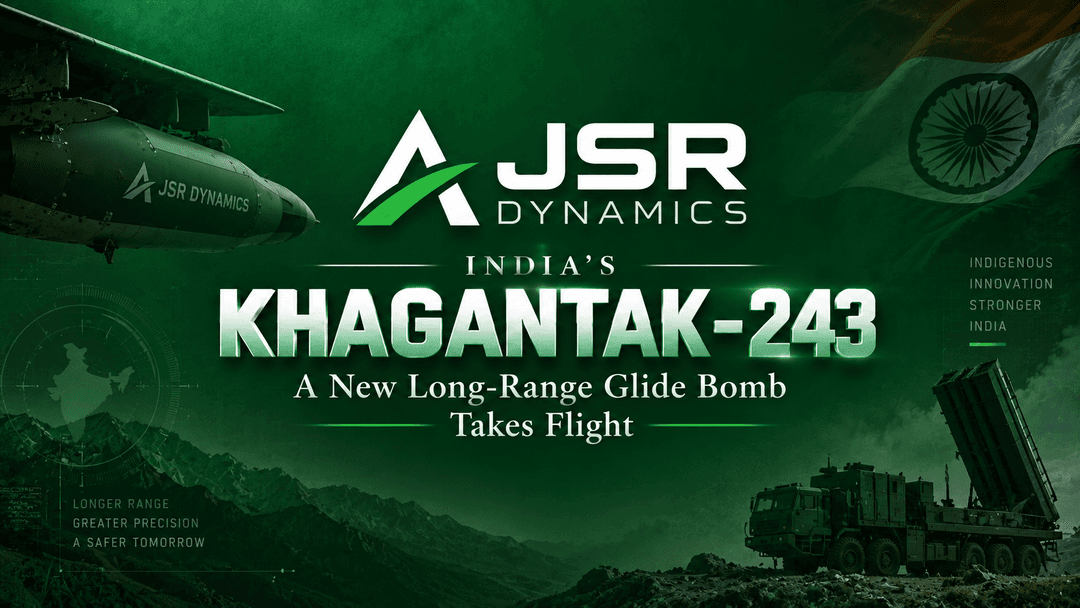
The Indian Air Force has notched up another milestone in indigenous weapons development, successfully drop-testing the Khagantak-243, a homegrown long-range glide bomb (LRGB) launched from a Su-30MKI fighter jet. The trial met all its planned flight objectives, marking a solid step forward for India's precision strike ambitions.
The Khagantak-243 belongs to the 300-kg weight class and is the product of a public-private partnership between Nagpur-based startup JSR Dynamics and defence PSU Bharat Electronics Limited (BEL). JSR Dynamics handled the aerodynamic airframe and control systems, while BEL contributed the guidance electronics — a collaboration model that reflects India's growing push to blend private innovation with public-sector defence manufacturing. Notably, close to 90% of the bomb's subsystems are reportedly built domestically.
Unlike a conventional bomb, the Khagantak-243 has no engine of its own. Once released from an aircraft, it uses swivel-type mid-body wings and five aft control surfaces to glide toward its target purely on aerodynamic lift. Dropped from an altitude of around 12 km at speeds close to Mach 0.85, it can cover a stand-off distance of roughly 140–180 km before impact.
That range is the real headline here — it lets IAF fighters strike high-value targets like runways, bunkers, and command centres from well outside the reach of enemy air defences.
The bomb combines an Inertial Navigation System (INS) with jam-resistant multi-GNSS for mid-course navigation, so it can still operate accurately even in GPS-denied environments. For its final approach, it can add INS/GNSS refinement, a passive homing head, or an optional electro-optical/infrared seeker, reportedly achieving accuracy within 10 metres CEP without a seeker, and under 5 metres with one. The warhead is a 125-kg Mk-81 blast-fragmentation charge.
The Khagantak-243 joins a growing family of indigenous Indian glide bombs — alongside DRDO's heavier 1,000-kg class Gaurav LRGB and the older Smart Anti-Airfield Weapon (SAAW) — that together are meant to reduce India's reliance on imported precision munitions. A wider domestic portfolio gives IAF planners more flexibility to mix aircraft, sensors, and weapons for different mission profiles, while also building up local manufacturing capacity and technical know-how for the long run.
JSR Dynamics is still squarely in the pre-revenue stage. The Nagpur-based company, founded in 2018, has so far put its energy into building and refining products — not selling them yet. That's simply how the defence startup playbook works: you spend years developing the weapon, then comes the testing phase (like this drop trial), and only after successful validation do government orders begin to flow in.
It's a long runway before cash comes in, and the company has been funded by patient capital along the way. JSR Dynamics has raised a total of $19.2M in funding from 49 investors — including institutions like Yes Bank and Niveshaay, along with over 30 angel investors — with the round closing in January 2025. That last fundraise was done at ₹6,514 per share, giving early backers a ringside seat to what could become a significant defence prime as orders materialise.
As of mid-2025, the company had around 43–51 employees, reflecting steady but measured growth as it scales toward production readiness.
The bet is straightforward: if the trials go well and the IAF places orders, JSR Dynamics transitions from a funded startup into a revenue-generating defence manufacturer almost overnight. The Khagantak-243 test is exactly the kind of proof point that makes that scenario more plausible.
For now, the successful trial is a promising checkpoint. The next steps will likely involve further validation rounds before any move toward induction into active service.
Based on recent reporting on the Khagantak-243 drop test from the Su-30MKI platform, and publicly available data on JSR Dynamics