
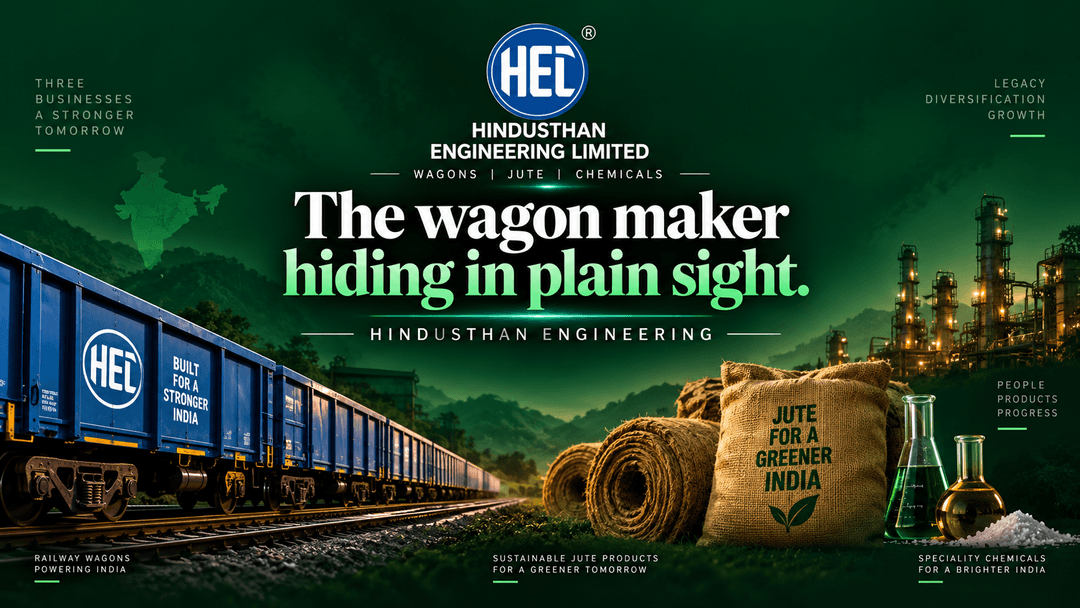
Quick question. Name India's biggest freight wagon makers.
You'd probably say Titagarh. Maybe Jupiter Wagons. Both are listed, both get written about constantly, both are sitting on market caps north of ₹10,000 crore.
Now here's a company you've almost certainly never heard of.
Last year it built and sold ₹2,052 crore worth of railway wagons. It made ₹172 crore in profit — more than Titagarh's ₹123 crore and more than Jupiter's ₹166 crore. It was the only one of the three that actually generated free cash. And its entire market value is about ₹1,544 crore. Roughly one-seventh of what the other two trade at.
It's called Hindusthan Engineering & Industries. It's headquartered in Kolkata, on Sir R N Mukherjee Road. And it's been quietly doing this for decades.
So what's going on? Is this the bargain of the decade, or is there a catch?
Let's read the annual report and find out.
Three things, but really one.
Wagons. Three-quarters of the company's ₹2,747 crore revenue comes from railway rolling stock — the freight wagons that haul coal, cement and steel across India. There's also a small but fast-growing business in "points and crossings," which is the track hardware that lets trains switch lines. That doubled last year, from ₹41 crore to ₹91 crore.
Jute. It owns the Dalhousie Jute mill in West Bengal. ₹400 crore of revenue, and a rounding error of profit — about ₹11 crore. Commodity business, thin margins, barely moves the needle.
Chemicals. A plant in Gujarat making sodium cyanide, potassium cyanide and rubber accelerators. Only ₹186 crore of revenue — but at a 21% margin, it's easily the best business in the building. Nobody talks about it.
And the wagon business itself? It's basically a steel conversion shop. Two-thirds of every rupee of revenue goes straight into buying steel. Labour is under 5%. You buy metal, you cut and weld it into a wagon, you deliver it to the Railways. The margin is thin — about 10% — and it's been thin for years, because the customer is the government and the government negotiates hard.
Revenue fell 7%. Wagon sales specifically fell 12%.
And this is where it gets interesting, because it wasn't really HEIL's fault.
Jupiter Wagons' managing director explained it on his earnings call in June. The first half of FY26 saw a prolonged shortage of wheelsets across the entire industry. Wheelsets are exactly what they sound like — the wheels and axle assembly that a wagon rolls on. No wheelsets, no wagons. Every manufacturer in India got squeezed.
Then, just as that eased, Q4 brought fresh trouble — LPG supply disruptions from geopolitical tensions, which hit the gas-fired processes in wagon fabrication.
Look at the damage across the sector:
Revenue change FY26 | Profit change | |
|---|---|---|
| Jupiter Wagons | −26% | −56% |
| Titagarh | −18% | −55% |
| HEIL | −7% | −21% |
Everyone got hit. HEIL just got hit least — partly because jute and chemicals cushioned it, partly because the listed players are spending heavily building new businesses that haven't started earning yet.
Enough context. Here's where the money comes from, split three ways.
Segment | FY26 revenue | FY25 revenue | Change | FY26 profit | Margin |
|---|---|---|---|---|---|
| Engineering (wagons + track) | ₹2,161 cr | ₹2,441 cr | −11.5% | ₹207 cr | 9.6% |
| Jute | ₹401 cr | ₹319 cr | +25.5% | ₹11 cr | 2.8% |
| Chemicals | ₹186 cr | ₹190 cr | −2.2% | ₹39 cr | 21.2% |
Look at that last column for a second.
Chemicals is 7% of revenue and delivers 15% of the profit. Jute is 15% of revenue and delivers 4% of the profit. One business is small and excellent; the other is large and barely worth running. And engineering — the wagon business — is everything else, at a middling 10% margin that got worse, down from 11.6%.
But segments hide the real story. Zoom in one more level, to individual products:
Product | FY26 | FY25 | Change |
|---|---|---|---|
| Railway rolling stock (wagons) | ₹2,052 cr | ₹2,327 cr | −11.8% |
| Jute goods | ₹400 cr | ₹318 cr | +25.6% |
| Sodium cyanide | ₹127 cr | ₹147 cr | −13.5% |
| Points & crossings (track hardware) | ₹91 cr | ₹41 cr | +120.7% |
| MPBAD cyanohydrin | ₹20 cr | ₹7.5 cr | +167% |
| Diphenyl guanidine | ₹20 cr | ₹23 cr | −13.9% |
| Steel castings | ₹1.5 cr | ₹16 cr | −90.9% |
Now it's obvious. One product — wagons — is three-quarters of the company. It fell ₹275 crore. Everything else put together couldn't make up the gap.
Oh, and one more line that doesn't show up in any segment: exports collapsed from ₹216 crore to ₹20 crore. Down 91%. HEIL is now a 99% domestic company.
FY26 | FY25 | Change | |
|---|---|---|---|
| Revenue | ₹2,747 cr | ₹2,950 cr | −6.9% |
| Raw materials | ₹1,796 cr | ₹2,039 cr | −11.9% |
| Employee cost | ₹135 cr | ₹138 cr | −2.3% |
| Other expenses | ₹477 cr | ₹514 cr | −7.2% |
| Finance cost | ₹35 cr | ₹44 cr | −21.5% |
| Operating EBITDA | ₹275 cr (10.0%) | ₹330 cr (11.2%) | −16.5% |
| Profit after tax | ₹172 cr | ₹218 cr | −21.2% |
| EPS | ₹116.98 | ₹148.46 | −21.2% |
| Dividend | Nil | Nil | — |
Here's the bit worth understanding.
Revenue fell 7%. Profit fell 21% — three times faster.
That's called operating deleverage, and it's what happens in a fixed-cost business when volumes drop. Your factories, your staff, your power bill, your interest — most of it doesn't shrink just because you built fewer wagons. So each lost sale takes a disproportionate bite out of profit.
You can see it in the margins. Raw materials as a share of revenue actually went up, from 66.6% to 68.3%, despite buying less steel. Return on equity fell from 13.6% to 9.6%.
Everything above says FY26 was a bad year. And on profit, it was.
On cash, it was the best year the company has had.
FY26 | FY25 | |
|---|---|---|
| Cash from operations | ₹212 cr | ₹186 cr |
| Capital spending | ₹46 cr | ₹63 cr |
| Free cash flow | +₹166 cr | +₹123 cr |
Operating cash rose 14% in a year when profit fell 21%.
How? Working capital. In FY25, the company sucked ₹86 crore into inventory and receivables. In FY26, it released ₹21 crore back out. A ₹107 crore swing.
And for every ₹100 of accounting profit, HEIL collected ₹123 of actual cash. Anything above ₹100 is a good sign — it means the profits are real and not sitting in unpaid invoices.
Meanwhile Titagarh's free cash flow was negative ₹45 crore. Jupiter's was negative ₹524 crore — its third straight year of burning cash, funded by raising money from shareholders.
So HEIL: smaller decline, higher profit, only positive cash flow in the group.
Sounds like a company handling a downturn rather well. Except there's a second problem, and the numbers above don't capture it.
The wheelset shortage was temporary. This one isn't.
Indian Railways hasn't placed a big wagon order in a while.
Think about what that means for a company where 75% of revenue is one customer's procurement cycle. You can have world-class factories and it doesn't matter — if the tender doesn't come, there's nothing to build.
Right now the whole industry is sitting on its hands, waiting. Titagarh has publicly said it is deliberately capping wagon output at 600–650 units a month, against a capability of 1,000, because it doesn't have clarity on new Railways tenders. Jupiter said the same thing in different words: keep execution moderate until the new order book arrives.
That's an entire industry idling by choice.
A very large tender.
The Mint reported in May that Indian Railways is preparing a procurement of roughly one lakh freight wagons worth ₹40,000 crore, spread over three to four years — around 35,000 to 40,000 wagons a year. First orders were expected between July and September.
Is that plausible? The underlying maths says yes. Titagarh's Umesh Chowdhary laid it out simply: Indian Railways runs about 4 lakh wagons. Roughly 4% wear out and need replacing every year. If GDP grows 6%, you need about 6% more capacity. Add them up and you get ~10% of 4 lakh — about 40,000 wagons a year, structurally, forever.
There's also the Dedicated Freight Corridor. Now, most retail investors assume the DFC means a flood of new wagon orders. Chowdhary pushed back on exactly this. He said there will be no separate large-scale wagon demand for the DFC. What the corridor does is remove bottlenecks, which raises how much freight the network can move, which eventually raises wagon requirement. It's a second-order effect, not an order book.
So the demand story is real. The timing is the problem.
As of now, the tender hasn't been floated. That July–September window has almost run out. And when an analyst asked Chowdhary directly whether it would come in three to six months, he refused to answer — twice. He said he didn't have enough information. Jupiter's Lohia was more confident, but even he wouldn't put numbers on it.
If HEIL made more profit than both listed peers, held up better in a bad year, and generated the only positive free cash flow in the group — why does it trade at 9 times earnings when they trade at 58 and 61?
Two answers. One is fair. One is uncomfortable.
The fair answer: you're not buying the same business.
Titagarh and Jupiter aren't valued on wagons at all. Jefferies literally calls the wagon segment "weak-growth." Titagarh's premium comes from passenger rail — Vande Bharat trains, metro coaches for Pune, Mumbai, Gujarat and Bengaluru. That's now 78% of its order book. Jupiter's comes from wheelsets, containers riding a new PLI scheme, brake systems and battery storage.
HEIL has wagons, jute and cyanide. No passenger business. No wheelsets. Exports collapsed from ₹216 crore to ₹20 crore — it's now 99% domestic. And its capital spending in the wagon division actually halved last year, from ₹58 crore to ₹32 crore, while capex in jute and chemicals tripled.
Management is quietly moving money away from wagons. Make of that what you will.
This is in the footnotes, and it takes some cross-referencing to see.
One. The auditor has issued a qualified opinion — two years running. In plain English: the auditor is formally saying "there are things here we cannot verify."
Two. Buried in Note 38 is ₹70 crore of interest owed to the company, accrued back in 1997, still outstanding. Cross-reference that against the related-party note and you find seven promoter-group companies with exactly ₹70.43 crore outstanding and zero interest received. The largest of them, Hindusthan Consultancy & Services, owns 41% of HEIL.
So: ₹70 crore of the company's money, sitting with the promoters, interest-free, for nearly thirty years. No provision made against it.
Three. The Chairman was paid ₹9 crore last year. The CFO was paid ₹33 lakh. That's 27x. In the same year, the board declared zero dividend — to "conserve the resources of the Company."
Four. And what did it do with those conserved resources? It put roughly ₹264 crore into mutual funds. Balanced advantage funds, multi-asset funds, and — genuinely — gold and silver ETFs. While simultaneously carrying ₹535 crore of short-term borrowing at 9.25%.
A wagon manufacturer, borrowing at 9.25%, buying silver ETFs, paying no dividend. It booked a ₹15.7 crore mark-to-market loss on the portfolio in year one.
Five. And the statutory audit fee for this ₹2,747 crore company, with eight plants across five states? ₹3 lakh.
This is the hope that gets people into the stock. Search for HEIL and you'll find a dozen sites calling it a hot pre-IPO opportunity.
The annual report mentions a listing exactly zero times. The audit annexure states plainly that no money has been raised through any public offer. The secretarial audit marks SEBI regulations as "not applicable."
Those websites selling you the shares? They're brokers earning a spread. "Upcoming IPO" is their pitch, not the company's plan.
And there are real obstacles. SEBI requires restated, clean financials in an offer document — a qualified opinion the auditor can't even quantify is a problem. Promoters hold about 84%, so getting to the mandatory 25% public float needs a big dilution. And the company is sitting on ₹753 crore of financial assets with almost no long-term debt, so it doesn't actually need the money.
Twenty-nine years incorporated. Still unlisted.
Here's the honest summary.
Underneath, there is a genuinely decent manufacturer. Strip out the idle investment portfolio and the core business earns about 17% on the capital employed in it. Cash conversion is excellent — ₹212 crore of operating cash against ₹172 crore of profit. It's a top-three player in an industry with a structural demand story that will, eventually, show up.
And wrapped around that decent manufacturer is a structure where the family holds 84%, pays itself ₹9 crore, has ₹70 crore of company money outstanding since the 1990s, publishes no order book, declares no dividend, and offers no way out.
The 9x multiple isn't the market being stupid. It's the price of all of that.
Whether it's the right price is a different question — and one nobody can answer without knowing the one number HEIL refuses to publish: how many wagons it actually has on order.
This is an explainer based on HEIL's FY2025-26 annual report, the Titagarh and Jupiter Q4 FY26 earnings calls, and public data from Screener. It isn't investment advice. Do your own homework — and if you're looking at unlisted shares, remember that getting out is much harder than getting in.