
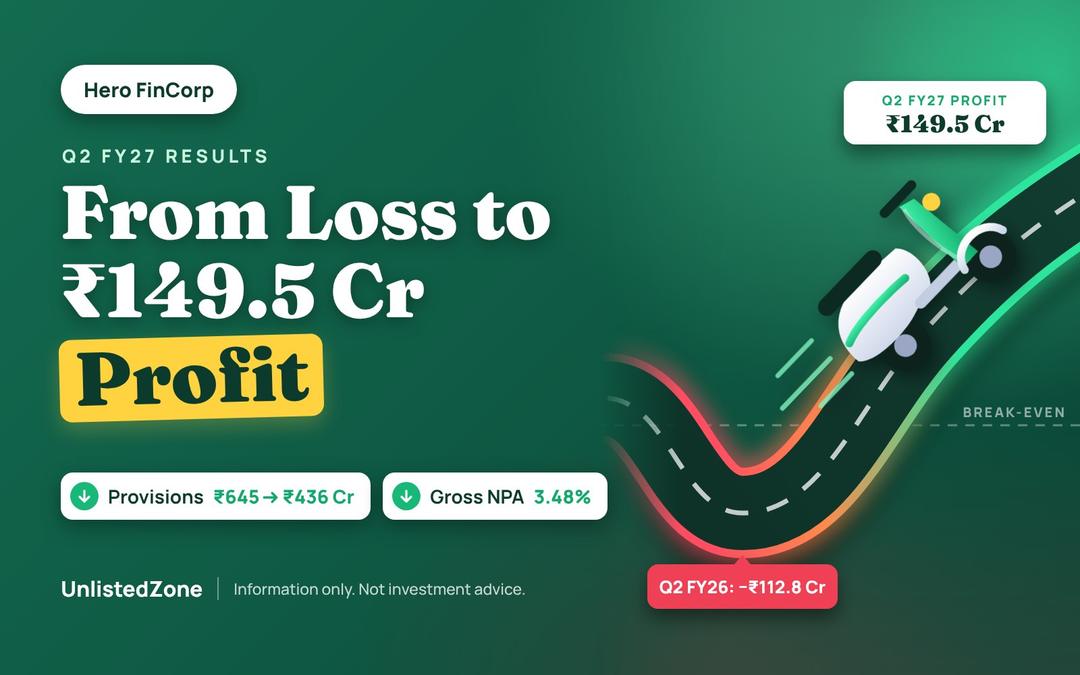
Hero FinCorp turned a ₹113 crore standalone loss into a ₹150 crore standalone profit this quarter, as gross NPAs fell from 5.41% to 3.48% in a year. Here’s what powered the comeback, and what to watch next.
Hero FinCorp reported a standalone profit after tax of ₹149.5 crore in Q2 FY27, compared with a standalone loss of ₹112.8 crore in the same quarter last year. Its gross NPAs fell from 5.41% to 3.48% in a year. Here’s what powered the comeback, and what to watch next.
Hero FinCorp swung from a ₹113 crore loss to a ₹150 crore profit this quarter. And behind that comeback is a loan book that's getting healthier every single quarter.
Today, we break down Hero FinCorp's Q2 FY27 standalone results (July–September 2026) and figure out where that sudden profit really came from.
If you've ever bought a Splendor on EMI, there's a decent chance Hero FinCorp paid for it.
Hero FinCorp is a diversified, tech-led NBFC and a part of Hero group. It started by financing Hero two-wheelers, then branched out into retail, MSME and corporate lending solutions. These include two-wheeler and electric vehicle financing, new and used car loans, personal and business loans. Today its loan book is worth nearly ₹50,000 crore, with the overall lending franchise becoming even larger when the business of its housing finance subsidiary, Hero Housing Finance Limited, is included.
Now, you can't buy Hero FinCorp shares on the stock exchange. But it raises money by selling bonds (called NCDs) to investors, and those bonds are listed on the NSE. That's why it has to publish its results every quarter, just like a listed company.
And the latest set of results marks a big step forward.
Hero FinCorp made a profit of ₹149.5 crore this quarter. A year ago, in the same quarter, it lost ₹112.8 crore.
Even compared to just three months ago, the jump is wild. Last quarter's profit was a tiny ₹8.4 crore. So this quarter's profit is almost 18 times bigger.
Zoom out to the full six months (April to September) and the picture holds. The company earned ₹158 crore, against a ₹163 crore loss in the same period last year.
Q2 FY27 | Q1 FY27 | Q2 FY26 | |
|---|---|---|---|
| Profit before tax (₹ cr) | 200.2 | 44.5 | –100.0 |
| Profit after tax (₹ cr) | 149.5 | 8.4 | –112.8 |
That's a remarkable turnaround for a lender that was in the red just a year ago.
So what's powering it? Let's break it down.
Mostly from a much healthier loan book.
Every lender knows some borrowers won't pay back. So it sets aside money in advance to cover those losses, like keeping an umbrella ready before the monsoon. This is called provisioning, and it gets deducted from profit.
A year ago, Hero FinCorp had to set aside ₹645 crore for bad loans in a single quarter. This quarter, it needed only ₹436 crore. Put another way, provisions used to eat 62% of its NII. Now they eat 42%.
The second big boost is an accounting quirk. In FY23, Hero FinCorp issued ₹2,000 crore of preference shares that will later convert into equity. Accounting rules treat them as debt and revalue them every quarter. A year ago, that revaluation cost the company ₹146 crore. This quarter, just ₹-0.6 crore. No real cash changed hands; it's a paper effect.
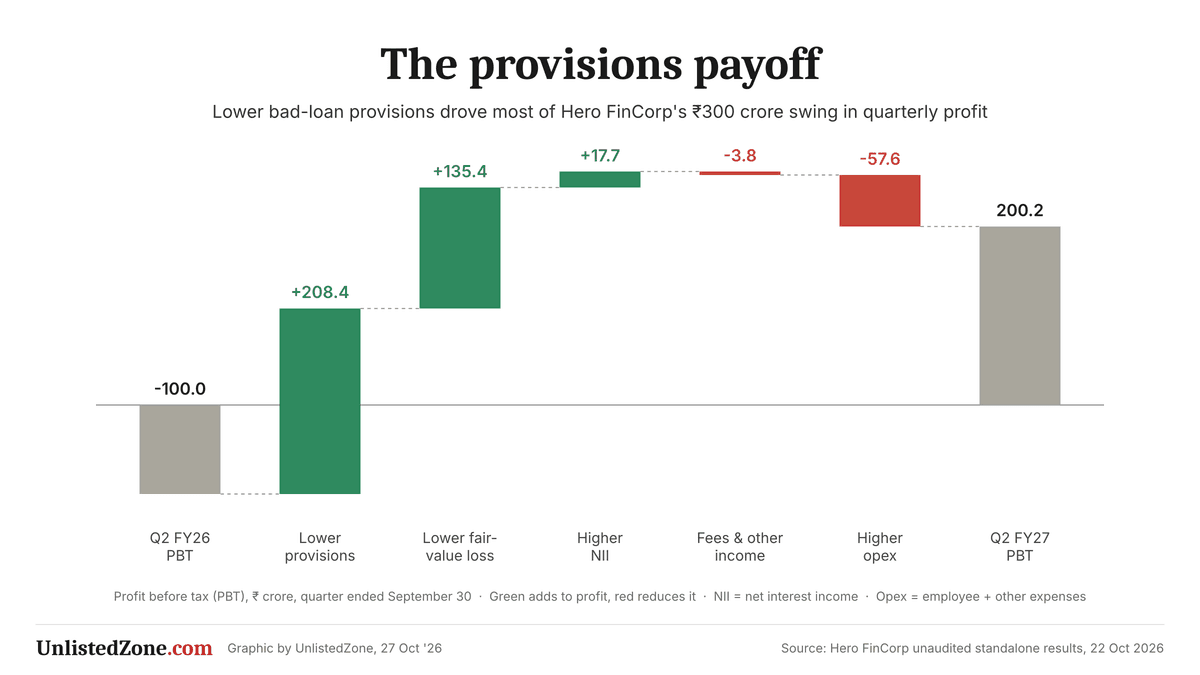
In short, the cleanup is paying off. Fewer bad loans mean less money locked away for losses, and more of it flows straight into profit.
The best part of these results is that bad loans are shrinking, quarter after quarter.
A loan becomes a Non-Performing Asset (NPA) when the borrower hasn't paid for over 90 days. Basically, money that's in danger of never coming back.
A year ago, out of every ₹100 Hero FinCorp had lent, about ₹5.41 had turned bad. Today, that number is ₹3.48. And it has fallen every single quarter in between:
Sep 2025 | Mar 2026 | Jun 2026 | Sep 2026 | |
|---|---|---|---|---|
| Gross NPA (%) | 5.41 | 4.23 | 3.77 | 3.48 |
| Net NPA (%) | 2.41 | 1.79 | 1.63 | 1.46 |
Net NPA is what's left after subtracting the money already set aside for those bad loans. At 1.46%, the hole in the balance sheet is now fairly small. The company has also covered 58.9% of its bad loans with provisions, up from 56.8% a year ago.
One thing to note. During these six months, the company sold 32,624 already written-off loans to an asset reconstruction company. Lenders also clean up NPA ratios by writing off loans, and the filing doesn't say how much was written off. So part of the improvement comes from cleanup, not just repayments. Either way, the trend is moving firmly in the right direction.
Every comeback story has a few things worth watching. Here are Hero FinCorp's.
Lots of borrowed money. Hero FinCorp's debt is 8.2 times its own capital. Lenders always run on borrowed money, but that's on the higher side. Even if you treat those preference shares as equity, it's 4.8 times.
A thinner safety cushion. Capital adequacy, the buffer a lender keeps against losses, slipped from 17.4% to 16.3% over the year. That's still above the RBI's 15% minimum for NBFCs.
Rising costs. Employee costs rose 11.5% over the year, ahead of NII growth.
Hero FinCorp has fixed its leaky bucket, and that's the hardest part of any turnaround.
The cleanup is real. Bad loans are down sharply, and the company is setting aside less money for them every quarter. That's what turned a loss into a profit.
The next chapter is growth. With a cleaner loan book and healthy margins, the company is well placed to lend more and earn more on each loan.
So here are two numbers to watch in the coming quarters:
NII growth. If it climbs into double digits, the business engine is back.
Credit cost. Provisions are still about 3.6% of loans a year. If that falls below 3%, the turnaround looks durable.
If both move the right way, this comeback could be just the beginning. For now, it's a very promising first act.
Until next time.
This article is for information only and is not investment advice. Source: Hero FinCorp's unaudited standalone results for the quarter ended September 30, 2026, filed with the NSE on October 22, 2026.