
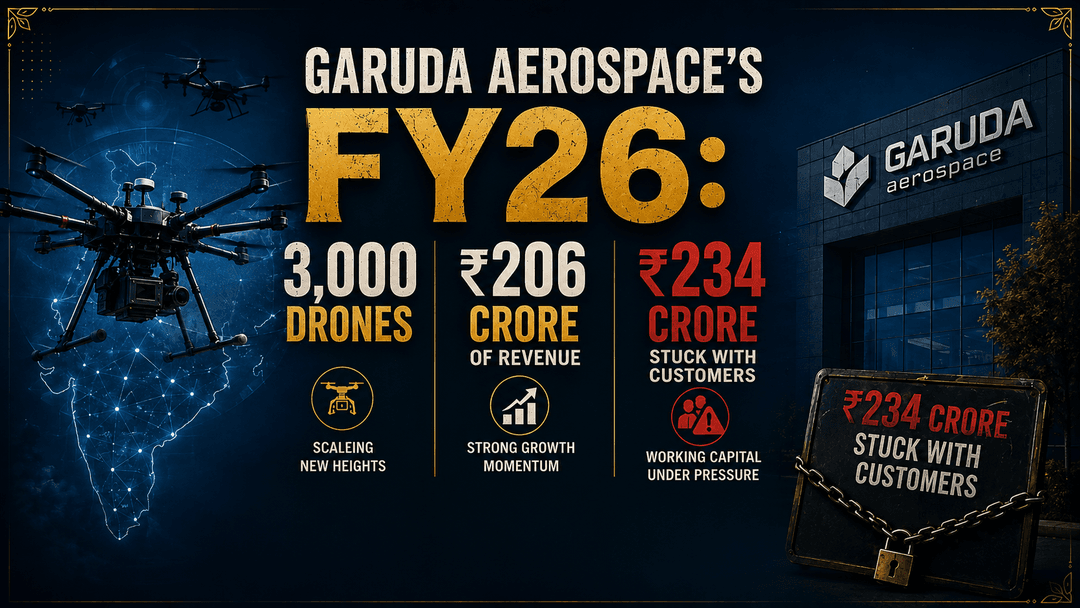
Garuda Aerospace started in 2015 in Chennai, close to a college project. Today it calls itself an "integrated drone technology company" — it builds drones, flies them for customers, and trains pilots.
Think of the business in two halves.
One, sell the drone. Agri drones, survey and mapping platforms, inspection systems, surveillance drones, logistics platforms, and now defence systems. This brought in ₹99.4 crore in FY26 — 48% of revenue.
Two, don't sell the drone, sell the flying. Under Drone-as-a-Service (DaaS), the customer doesn't buy anything. Garuda sends its own fleet and its own pilots, does the job, and hands over the data. This brought in ₹106.5 crore — 52%. Services are now bigger than product sales.
The Annual report lays out six verticals:
Vertical | What they do |
|---|---|
| Agriculture | Precision spraying, crop monitoring, seed spreading, agri intelligence |
| Defence & Homeland Security | ISR, tactical surveillance, mission systems, autonomous platforms |
| Industrial & Infrastructure | Surveying, mapping, inspection, progress monitoring, asset intelligence |
| Drone-as-a-Service | Deployment on contract across multiple sectors |
| Software & Data Intelligence | Mission planning, fleet management, AI analytics |
| Training & Skilling | DGCA-approved RPTO, 300+ centres, 2,000+ licensed pilots |
On top of that sits after-sales — MRO, spares, annual maintenance contracts.
Two things genuinely set them apart. First, dual DGCA approval for both manufacturing and training — the Annual report claims they were the first Indian drone company to have it. That lets them run BVLOS and government or defence missions without leaning on a third party, which is exactly where the large contracts live. Second, the shift out of agriculture. CY25 saw a landmine breaching system and a rocket launcher drone, plus a defence surveillance order. CY26 added an MoU with BEL, making it their third Defence PSU partnership.
One thing that doesn't match the cover, though. The Annual report is themed "Indigenous Innovation, Global Impact" and the company claims a presence in 16 countries. But the Ind AS geography disclosure shows export revenue of zero in FY26, and ₹3.9 lakh in FY25. For now this is a 100% India business.
A caveat before the tables. This is the year the company moved from Indian GAAP to Ind AS, so FY25 has been restated. The FY25 revenue you may have seen elsewhere (~₹118 crore) now reads ₹123.5 crore. Don't try to tie this back to older write-ups.
(All figures in ₹ crore. The Annual report is in ₹ million — divided by 10.)
Particulars | FY26 | FY25 | Change |
|---|---|---|---|
| Revenue from operations | 205.96 | 123.46 | +67% |
| Cost of materials consumed | 116.82 | 72.32 | +62% |
| Employee benefit expenses | 8.02 | 9.55 | –16% |
| Other expenses | 29.21 | 29.13 | flat |
| Impairment on financial assets | 11.13 | 0.07 | 170x |
| Depreciation | 4.08 | 3.60 | +13% |
| Finance costs | 1.04 | 1.23 | –15% |
| PBT | 34.06 | 25.41 | +34% |
| Tax | 8.15 | 7.04 | +16% |
| PAT | 25.92 | 18.37 | +41% |
| EPS (basic) | ₹4.99 | ₹3.67 | +36% |
From the top, this looks excellent. Revenue up 67%, profit up 41%, and the company is genuinely profitable.
From the bottom, two things stand out.
First, margins actually shrank. The Board's Annual Report celebrates a 19.2% EBITDA margin. But FY25's EBITDA margin was 23.4%, and FY26's is 18.9%. Revenue grew 67% and operating leverage went the wrong way. A big reason is that ₹11.13 crore impairment charge — old receivables going bad. More on that shortly.
Second, the salary bill fell. Revenue grew 67% while employee costs dropped 16% to ₹8.02 crore. The company claims 200+ team members, which works out to roughly ₹3.5 lakh per person per year. That's very low for a self-described deep-tech company. The explanation is buried in the notes: cost of materials includes "outsourced contract cost" of ₹51.87 crore — 25% of revenue. A large chunk of the manufacturing and service delivery is done by someone else. That's what "asset-light, service-led model" means in practice.
One more detail: FY25 revenue included ₹5.78 crore of PLI incentive — a government subsidy. FY26 has none.
Particulars | Mar-26 | Mar-25 |
|---|---|---|
| Trade receivables | 234.40 | 111.95 |
| Inventories | 34.27 | 24.59 |
| Cash & cash equivalents | 2.39 | 0.95 |
| Property, plant & equipment | 17.98 | 15.17 |
| Right-of-use assets | 7.37 | 0.11 |
| Total assets | 359.62 | 209.03 |
| Net worth | 239.84 | 165.59 |
| Borrowings (all current) | 22.27 | 6.71 |
| Trade payables | 64.55 | 25.82 |
| Debt/Equity | 0.09 | 0.04 |
There's almost no debt here. D/E of 0.09 is genuinely clean.
But now look at the one line that changes the whole story: trade receivables of ₹234.4 crore. Revenue was ₹206 crore. The company has more money stuck with customers than it billed all year.
Debtor days: 415. On gross receivables, 431.
And then there's the ageing schedule, which is the most uncomfortable table in the Annual report:
Bucket | Amount (₹ cr) |
|---|---|
| Not due | 0.00 |
| Overdue < 6 months | 155.99 |
| Overdue 6–12 months | 39.63 |
| Overdue 1–2 years | 40.96 |
| Overdue 2–3 years | 6.70 |
| Gross total | 243.28 |
| Less: provision | (8.88) |
The "Not Due" column is zero. Meaning as on 31 March 2026, not a single rupee of receivables was still within its credit period — the entire ₹243 crore had already crossed its due date. ₹87.3 crore of it was more than six months old, and ₹47.7 crore more than a year.
Against all that, the provision is ₹8.88 crore — 3.7% of gross. During FY26 the company took a fresh ₹11.11 crore provision and wrote off ₹5.11 crore.
The charitable reading: the customers are PSUs and government agencies, and government payment cycles are notoriously slow. The less charitable reading: revenue is being recognised, cash isn't arriving.
Particulars | FY26 | FY25 |
|---|---|---|
| Operating cash before working capital | 50.34 | 30.23 |
| Increase in trade receivables | (133.56) | (20.05) |
| Increase in trade payables | 38.73 | 10.69 |
| Taxes paid | (6.62) | (2.89) |
| Cash from operations (CFO) | (41.55) | (23.64) |
| Capex | (13.31) | (15.30) |
| Cash from investing | (19.46) | (15.93) |
| Equity + preference issue | 17.74 | 47.14 |
| CCD (convertible debenture) issue | 31.47 | 3.52 |
| Unsecured borrowings | 10.83 | — |
| Cash from financing | 51.46 | 30.72 |
| Net change in cash | (9.54) | (8.86) |
The company earned ₹25.92 crore of PAT and burned ₹41.55 crore of cash from operations. Over two years, cumulative CFO is –₹65.2 crore.
The entire gap was plugged with investor money — ₹17.74 crore of equity, ₹31.47 crore of CCDs, and a ₹9 crore loan from director Rithika Mohan.
And the closing balance? Per the cash flow statement, cash and cash equivalents at year-end were negative ₹8.59 crore, because the ₹10.98 crore ICICI bank overdraft nets off against it. Actual money in the bank: ₹2.39 crore.
A profitable company sitting on ₹2.4 crore of cash and ₹234 crore of receivables. That's the core tension of this annual report.
On UnlistedZone, the indicative price on 30 August 2026 is ₹438, implying a market cap of roughly ₹2,321 crore. The 52-week range is ₹425–₹495, and the price is down 11.5% over six months.
Run the multiples on actual FY26 numbers:
Metric | Value |
|---|---|
| Market cap | ~₹2,320 cr |
| P/E (FY26 EPS ₹4.99) | ~88–90x |
| P/S | ~11.3x |
| P/B (BVPS ₹45.3) | ~9.7x |
| EV/EBITDA | ~60x (~47x if you add back the impairment) |
| ROE | 12.78% |
| ROCE | 13.61% |
The Annual report discloses the FY26 private placements: CCDs at ₹1,75,335 per debenture, and equity on 16 August 2025 at ₹1,78,758 per share.
After that came an 85:1 bonus (1 share becomes 86) and a ₹10-to-₹2 split (×5). So one old share equals 430 shares today.
Adjusted, the last primary round priced the stock at roughly ₹408–₹416.
Today's ₹438 is only 5–7% above that — a year later, with revenue up 67% in between. Either the unlisted market had already priced in a lot, or it has started noticing the receivables problem. The 11.5% six-month decline points to the second.
Put plainly: at ₹438 you're paying ₹2,320 crore for a company that earned ₹26 crore and burned ₹42 crore of cash.
1. The Board's revenue claim doesn't match the audited numbers. The directors write that "Garuda surpassed Rs. 250 crore in revenue." Audited revenue is ₹205.96 crore. What makes it stranger is that the EBITDA margin (19.2%) and PAT margin (12.57%) quoted in the same paragraph only work on a ₹206 crore base. The Annual report contradicts itself on its own page.
2. Zero receivables in the "Not Due" bucket. Every rupee of the ₹243 crore gross receivable was overdue at year-end.
3. Two straight years of negative operating cash flow. –₹41.55 crore in FY26, –₹23.64 crore in FY25. Growth is being funded by investors, not by the business.
4. Year-end cash is negative. –₹8.59 crore after the ICICI overdraft.
5. Advances parked with a promoter-linked entity. The company's entire ₹12.93 crore of capital advances sit with Agni Estates and Foundations Pvt Ltd — an entity where KMPs or their relatives have significant influence. It was ₹6.49 crore a year ago. Another ₹1.13 crore of "other advances" sits with the same entity. In FY25, ₹10.08 crore was with Vishnusurya Projects, another promoter-linked entity. Lease payments also flow to promoter-linked parties.
6. ₹12.04 crore of raw material is lying with a supplier. Out of ₹18.26 crore of raw material, 66% isn't on the company's own premises. It's disclosed in a one-line footnote.
7. An odd shift in payables. Dues to micro and small enterprises collapsed from ₹13.66 crore to ₹0.58 crore, while dues to other creditors jumped from ₹12.16 crore to ₹63.98 crore. Payable days are around 202. Given how MSME payment rules work, that reclassification is worth a second look.
8. Where is the R&D? A company built on "indigenous innovation" spent ₹1.24 crore on R&D in FY26 — down 84% from ₹7.60 crore, and just 0.6% of revenue. The report itself notes that the criteria for capitalising development costs are "not met at this stage."
9. Unpaid advance tax. In the CARO report, the auditor flags ₹3.19 crore of advance tax (the June and September 2025 instalments) as "not yet paid" as at 31 March 2026.
10. The credit risk note contradicts itself. One line says the company has "major business dealings with few parties." The very next says "there is no significant concentration of credit risk." Both can't be true.
11. Small inconsistencies that add up. The corporate overview says the leased facility is 59,335 sq ft; the Board's Report says 70,000 sq ft. One page says "2,500+ pilots trained," another says "over 2,000 DGCA licensed pilots." One says 400+ cities and 28 states, another says 300+ centres across 22 states. The CARO clause numbering is garbled, and it states the company made no investments — while the balance sheet carries a ₹0.50 crore investment in Zuppa Geo Navigation.
12. Comparability. This is a first-time Ind AS adoption, which is what the auditor's Emphasis of Matter is about. Comparing against previously published FY24/FY25 figures won't tie.
13. Standalone only. The US subsidiary, Garuda Technology Inc., was acquired after year-end, so there's no consolidated picture here.
The auditor, S R B R & Associates LLP, gave a clean opinion. No qualification. The Emphasis of Matter is only about the Ind AS transition, which is routine.
Clean opinion on internal financial controls too.
No loan defaults, no wilful defaulter tag, no reported frauds, D/E of 0.09.
Customer concentration improved sharply. In FY25 a single customer accounted for 38% of product sales; in FY26 the top customer is just 7.77% of revenue.
Founder Agnishwar took zero remuneration. Rithika Mohan took ₹48 lakh.
₹13.3 crore of capex, the Oragadam facility, three Defence PSU partnerships, DGCA train-the-trainer authorisation. Money is going into the business.
The IPO process is described as "currently in progress" — ₹0.43 crore of deferred IPO expenses sit on the balance sheet.
Garuda Aerospace comes with two very different report cards.
The P&L report card: 67% revenue growth, real profits, entry into defence, falling customer concentration, and a regulatory moat in dual DGCA approval. That's a good growth story.
The balance sheet and cash flow report card: 415 debtor days, every rupee of receivables overdue, two years of negative operating cash flow, ₹2.4 crore in the bank at year-end, and advances parked with promoter-linked entities. That's a warning.
At ₹438, the market is pricing only the first report card — 88x earnings, 60x EV/EBITDA.
The real question isn't whether the drone industry will grow. It will. The question is when Garuda collects its ₹234 crore — and if the collection cycle stays this stretched, how much more equity it will have to issue to fund next year. The IPO preparation should be read in exactly that context.
Until operating cash flow turns positive, revenue growth is just an accounting entry.
This article is based on Garuda Aerospace Limited's FY2025-26 Annual Report (audited standalone Ind AS financials, auditor's report dated 17 August 2026) and UnlistedZone's indicative price as of 30 August 2026. Unlisted share prices are indicative rather than exchange-traded — they are illiquid, volatile, and carry no guarantee of an IPO. This is not investment advice. Do your own due diligence or speak to a SEBI-registered adviser.