
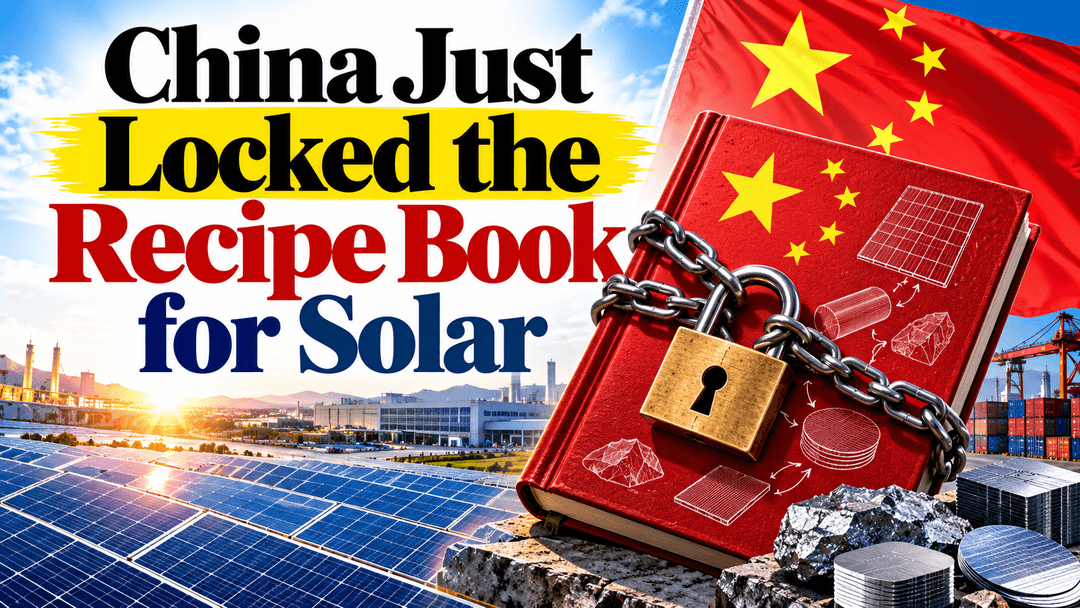
Imagine the best biryani shop in your neighbourhood. For years, it happily sold you biryani. It also sold you its big handis, and even sent its cook over to train your staff.
Now the shop has a new rule. You can still buy the biryani. But the recipe for its newest dishes is no longer for sale. And the handis and the cook? You'll need the shop's permission first.
That, in short, is what China did to the world's solar industry on October 16, 2026. And India, which is busy trying to open its own biryani shop, may feel it the most. So let's break it down.
China proposed controls on 12 technologies used to make solar equipment, citing national security. It sorted them into two buckets.
Bucket 1: Banned outright. These are China's crown jewels:
Technology to make perovskite and tandem cells. These are next-generation cells that squeeze far more power out of sunlight.
Technology to make ultra-thin silicon wafers, 70 micrometres or less. That is roughly as thin as a human hair.
A cheaper, cleaner way to make polysilicon, the purified silicon that everything else is built from.
Bucket 2: Allowed, but only with permission. This covers TOPCon, HJT and back-contact (XBC) cells. These are the workhorse cell types that most new factories use today.
Two bits of fine print matter a lot:
It's still a draft. Public comments are open until November 15, 2026. But one part is already live: Chinese companies must now register with the government before sending these technologies abroad.
Finished products aren't blocked. China will still sell you solar panels, and even cells and wafers. What it's locking up is the know-how and the machines to make them yourself.
That second point is the whole game. China isn't stopping the biryani. It's guarding the recipe.
Reuters adds one more detail: China has already been curbing solar-manufacturing technology exports to India specifically. Analysts see it as China protecting its lead while India tries to build its own industry.
First, a quick lesson in how a solar panel is made. It goes in four steps: polysilicon → wafer → cell → module (the panel).
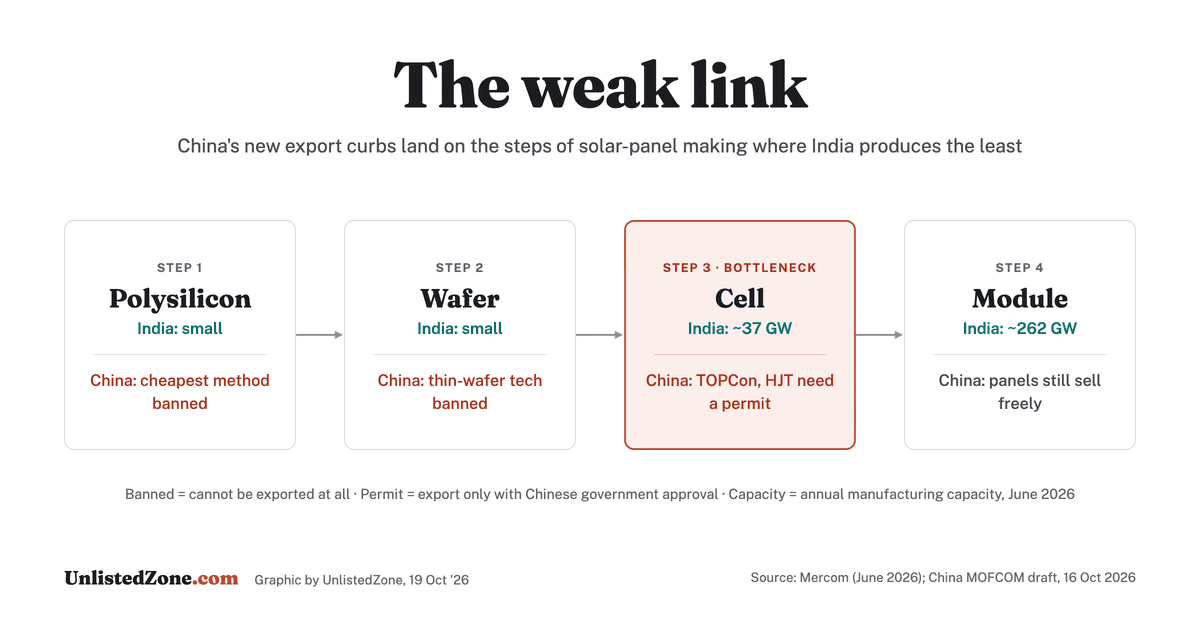
India is strongest at the last step. China's new rules land on the steps before it, and the cell step is where India is already short.
The cell is the important bit. It's the thin blue square that actually turns sunlight into electricity. The module is mostly assembly: you line up the cells, add glass, a frame and wiring.
India is brilliant at the assembly part. It's still small at the cell part. By June 2026, India could make about 262 GW of panels a year, but only about 37 GW of cells. For TOPCon, the most popular type, the gap is wider still: roughly 172 GW of panel capacity against about 10 GW of cells.
Think of it as a giant tiffin-box factory that makes very little of the food that goes inside.
The government wants to fix this. Under a rule called ALMM List-II, government-backed solar projects must now use Indian-made cells. Some rooftop and open-access projects got a breather, but that ends on December 31, 2026.
So every big company is racing to build cell factories. Here's the catch: most of those factories run on Chinese machines, set up by Chinese engineers. One study found that all 17 of Waaree's listed supply-chain partners were Chinese. And that is exactly what China just put behind a permission gate.
It depends on how far along a company's plans are.
1. Factories already running: mostly fine. The machines are already installed and humming. The worry is servicing. Spare parts, upgrades and visits from Chinese technicians may now need Beijing's approval, so fixes could get slower.
2. Factories being built: this is where it hurts. A new cell line needs Chinese engineers to install and switch it on. If every such job needs a licence, timelines slip and costs rise. Santosh Pai of the Institute of Chinese Studies warned that India's first wave of cell makers could see delays in starting production.
And timing is everything here. A cell factory that opens six months late misses six months of the shortage, which is exactly when cells are most profitable to sell.
3. Going deeper into wafers and polysilicon: harder still. India already plans to require Indian-made wafers from June 2028. China has now banned the technology for the thinnest wafers and the cheapest polysilicon process. So India's next big step just got steeper.
If new cell factories open late, the cell shortage lasts longer. That's bad for the country. But it's good for whoever already has cell lines running, because scarce things sell at higher prices. Wood Mackenzie already expects utility-scale solar system prices in India to rise 20% by the end of 2026 because of the cell crunch.
So not every solar company is hurt equally:
Better placed: companies with cell factories already producing.
More exposed: companies that mostly assemble panels and whose cell plans are still on paper.
The honest answer: no single country can replace China. It dominates almost every step. But there are options at each step, just smaller and pricier.
Step | Who else can supply | The catch |
|---|---|---|
| Polysilicon | Germany (Wacker), Malaysia (OCI), US (Hemlock), Japan (Tokuyama) | Costs more; limited volumes |
| Wafers | Almost nobody at scale | The real gap. India will keep buying Chinese wafers as products, which aren't banned |
| Cell machines and know-how | Germany (centrotherm, Singulus, Fraunhofer ISE), US/Italy (Applied Materials), South Korea (Jusung, Hanwha Qcells), Japan (Kaneka) | Pricier, longer waits, can't equip dozens of factories quickly |
The equipment names come from general industry knowledge; treat them as a starting list, not a verified supplier directory.
In practice, India will probably use a mix. The government can negotiate licences, since TOPCon is "restricted," not banned. Companies can buy some lines from Europe, Korea or Japan. And everyone will have to spend more on their own R&D. Slower and costlier, yes. But it's also how real self-reliance gets built.
If you're planning rooftop solar: prices could stay firm for a while if cells remain scarce. Panels won't vanish, though, because finished products aren't blocked.
If you hold solar stocks: a headline like this can trigger a sharp sell-off. But remember that running factories aren't directly hit. The real risk is to future expansion timelines, not today's output. Three things are worth watching:
The final rules after November 15.
Whether Indian companies actually get licences approved.
What companies say about whether their machines are already delivered.
This is context, not investment advice.
The bottom line: China isn't taking the biryani off the menu. It's locking the recipe in a safe. India's real test now is whether it can learn to cook on its own, and how fast.
Until then...