
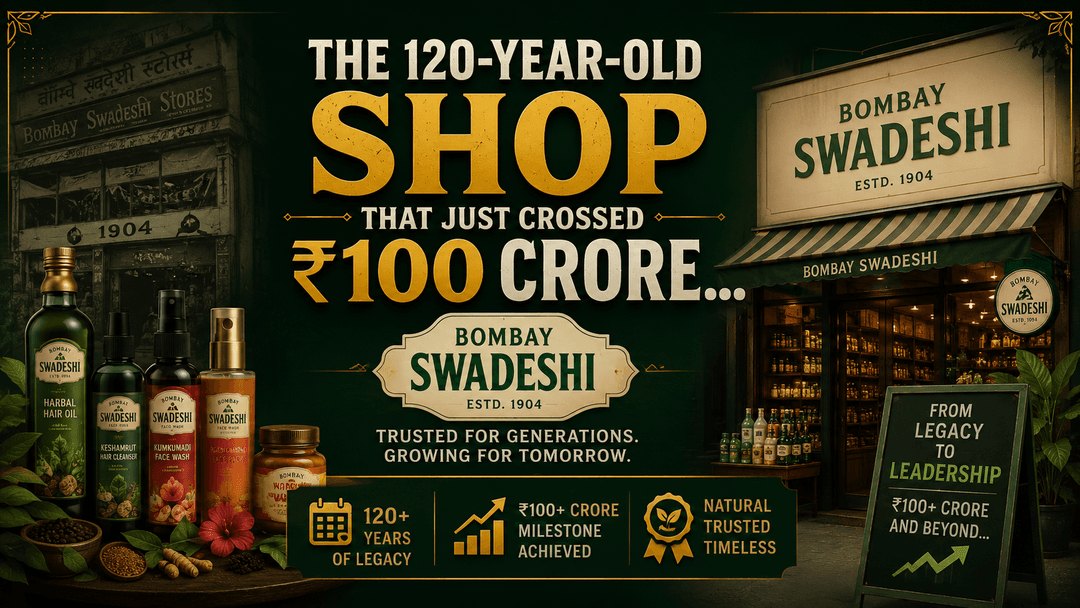
In 1906, when the Swadeshi movement was asking Indians to buy Indian, a shop opened in Bombay's Fort district selling exactly that. Handicrafts, textiles, household goods — all made in India, at a time when that was a political statement rather than a marketing line.
That shop is still open. It's called The Bombay Store now, it's owned by a company called Bombay Swadeshi Stores Limited, and it just filed its 120th annual report.
And for the first time in those 120 years, it crossed ₹100 crore in revenue.
So let's talk about what the company actually does, and whether the year was as good as that milestone makes it sound.
Strip away the heritage and Bombay Swadeshi is a fairly simple retailer.
It buys finished handicrafts, home décor, furnishings, pashmina and wellness products from artisans and suppliers. It marks them up. It sells them across 30 stores in about 13 cities — Mumbai, Pune, Bengaluru, Hyderabad, Jaipur, Kochi, Visakhapatnam and others.
There's no factory. No manufacturing. In FY26 it bought ₹50.5 crore of merchandise and sold ₹100 crore worth. That's a gross margin of roughly 52% — and that gap is the entire business.
Three things follow from this model.
One — it's a landlord's business as much as a retailer's. Every one of those 30 stores is leased. Rent came to ₹14.8 crore, or about 15% of revenue, making it the single largest expense line after the cost of goods. Growth here means signing leases and fitting out stores, not buying real estate. Net fixed assets on the balance sheet are just ₹3.5 crore.
Two — the money sits in inventory. Stock worth ₹22.4 crore is the biggest asset the company owns. Meanwhile receivables are almost nothing — ₹23 lakh — because people pay at the counter. Retail cash conversion at its most basic.
Three — there's a quiet export business. Foreign exchange earnings were ₹17.8 crore, roughly 18% of revenue, coming from exports and foreign-currency counter sales. Tourists walking into a Colaba or Jaipur store are a real revenue line here.
One more thing that's unusual. The company has no bank debt at all. The only borrowing is a ₹7 crore interest-free loan from a promoter-director. Total finance cost for the year: ₹23,000. Yes, thousand.
It's worth being concrete about this, because "handicrafts retailer" can mean anything from a footpath stall to a gallery.
The catalogue is organised into six broad buckets:
Artefacts — idols and figurines in brass, iron, wood, stone, resin, silver and bone, plus Ashoka pillars, urlis and singing bowls. There's even a "Masterpieces" shelf.
Ganesha — big enough to be its own top-level category, split by material.
Home décor — wall frames, clocks, paintings, toranas, diyas, lamps, bells, chowkis, cushion covers, tableware, serveware, drinkware and some furniture.
Graphic Works — printed tableware, drinkware, bags, diaries, umbrellas and t-shirts. This is the design-led, repeat-purchase end.
Accessories — tote, sling and laptop bags, wallets, jewellery, wraps, wellness products.
Souvenirs and stationery — brass and wood bookmarks, diaries, mementos, dolls, toys.
Underneath that sits a set of craft-named design collections that do the real branding work — Madhubani, Ajrakh, Bastar Dokra, Blue Pottery, Pichwai, Bani Thani, Royal Jharokha, Mughal Floral. Each craft is mapped across formats, so the same Madhubani motif shows up on a diary cover, a tote bag and a coaster set.
Now here's the part that matters for the numbers. Look at the price ladder.
Product | Price | |
|---|---|---|
| Entry | Ajrakh coaster set of 6 | ₹795 |
| Madhubani leather diary case | ₹950 | |
| Pichwai reversible umbrella | ₹1,595 | |
| Mid | Brass Ganesha with stonework, 6 in | ₹4,600 |
| Bastar Dokra peacock boat | ₹9,500 | |
| Teakwood chest with brass fittings | ₹20,000 | |
| High | Camel bone flower vase, 30 in | ₹55,000 |
| Bastar Ramdarbar on elephant | ₹1,20,000 | |
| Labradorite stone Shiva head | ₹1,95,000 |
(Indicative online prices at the time of writing.)
That's a 250x spread between the cheapest trending product and the most expensive showpiece. And the online store is explicitly built around gifting — sorted by budget (under ₹500, ₹501–1000, ₹1001–2500, ₹2501–5000) and by occasion (wedding, festival, housewarming, corporate), with a dedicated corporate gifting catalogue.
Two consequences show up directly in the financials.
One — this is why inventory is so heavy. Bombay Swadeshi holds roughly 160 days of stock. A ₹1.95 lakh stone Shiva head might sit on a shelf for a year. You cannot run a "treasure trove" format on lean inventory, because the browsing is the product. That ₹22.4 crore of stock isn't sloppiness — it's the business model, and it's where most of the shareholder's capital lives.
Two — the gifting skew makes the year lumpy. Diwali, wedding season and corporate gifting cycles will drive a disproportionate share of the ₹100 crore. The company doesn't publish quarterly numbers, so unlisted holders don't get to see that seasonality — only the annual total.
One last detail that ties back to the export line: the website offers English, Hindi and Dutch. That's an odd third choice unless you're deliberately serving overseas buyers — consistent with the ₹17.8 crore of foreign exchange earnings.
Here's the scoreboard.
FY26 | FY25 | Change | |
|---|---|---|---|
| Revenue | ₹100.01 cr | ₹88.77 cr | +12.7% |
| Profit after tax | ₹10.31 cr | ₹8.72 cr | +18.3% |
| Net margin | 10.31% | 9.82% | +49 bps |
| EPS | ₹20.87 | ₹17.65 | +18.2% |
| Operating cash flow | ₹7.07 cr | ₹0.80 cr | ~9x |
| Debt / Equity | 0.20 | 0.46 | improved |
Profit grew faster than revenue. That's the headline. Gross margin held steady at 52.1%, and the fixed cost base got spread over a bigger number.
The cash flow line is arguably the better story. Operating cash went from ₹0.80 crore to ₹7.07 crore — largely because FY25 had a one-off working capital hit that didn't repeat. That cash let the company repay ₹4.71 crore of the promoter loan, spend ₹1.45 crore on capex, and still end the year with more in the bank.
Net worth is now ₹35.65 crore. On 49.4 lakh shares, that works out to a book value of about ₹72 per share.
The company added three stores this year — SkyCity Mall Mumbai, Y Junction Hyderabad, Inorbit Visakhapatnam. Store count went from 27 to 30, an 11% jump.
Revenue grew 12.7%.
Do the crude maths and revenue per store went from ₹3.29 crore to ₹3.33 crore. Barely moved.
Now, that's rough — new stores opened partway through the year and don't contribute twelve months of sales, so this understates same-store performance. But the company doesn't disclose like-for-like growth, which means you can't cleanly separate "more stores" from "better stores." For anyone underwriting this as a compounding retail story, that's the number you'd most want and don't get.
Costs are also creeping. Employee expense rose 18.5% (headcount went from 213 to 245) and rent rose 12.9% — both faster than revenue.
And there's a legal overhang. The company's MG Road, Pune store is stuck in a long-running eviction dispute with its landlord. The auditors flagged it as an emphasis of matter. Bombay Swadeshi has ₹5.21 crore deposited with the court — that's about 15% of its entire net worth, sitting frozen — plus ₹5.5 lakh going out every month as interim compensation. The writ petition was scheduled for hearing on 20 August 2026.
The Labour Codes. India's four new labour codes came into effect on 21 November 2025. Bombay Swadeshi took a ₹3.53 lakh exceptional charge for past service cost — trivial. But the note also says the company has restructured employee compensation with effect from 1 April 2026 to comply. That cost lands in FY27, not FY26.
The board changed after year-end. In August 2026, the company appointed two independent directors — Sweety Jain and Amol Modani, both chartered accountants. Until then the board was three non-executive promoter-family directors and nothing else. The report gives no reason beyond the usual language, so read into it what you will, but it is a genuine governance change.
A few things specific to how this share trades.
It's tightly held. Three promoters — Jyoti Kabra (30.27%), Manjri Chandak (29.29%) and Madhu Chandak (29.29%) — hold roughly 89% between them. Zero change during the year. That leaves a small float, which usually means wide bid-ask spreads and thin volumes.
No dividend. Again. The board declined one "to conserve resources." It hasn't paid one in years. Every rupee of profit stays in reserves, which have swelled from ₹24.35 crore to ₹34.66 crore.
That last point explains something odd in the numbers. Return on equity actually fell — from 41.6% to 33.8% — even though profit went up 18%.
Nothing went wrong. ROE is profit divided by shareholders' funds, and while profit grew 18%, equity grew 45% — because every rupee earned stayed in reserves. When the bottom of the fraction grows faster than the top, the ratio shrinks. Expect it to keep drifting down as long as the dividend stays at zero.
And the debt picture flatters slightly. The company's near-zero interest cost isn't a sign of superior treasury management — it's a promoter lending money for free. Perfectly legitimate, but if you're comparing return ratios against a listed retailer paying market rates, the comparison isn't apples to apples.
This is the part most people skip to, so let's do it properly.
UnlistedZone's indicative level for Bombay Swadeshi is ₹470 a share. With 49,40,000 shares outstanding, that's a market cap of roughly ₹232 crore. Lot size is 50, so a minimum ticket is about ₹23,500.
Two caveats before we build anything on that number. First, it's an indicative level compiled by the platform — not a live quote, not an exchange price, and not an offer to deal. Second, the level on the page carries an "as of" date, so check how recent it is before you anchor on it. Unlisted prices move in steps, not ticks.
With that said, here's what ₹470 implies against the freshly filed FY26 numbers.
Metric | FY26 basis | At ₹470 |
|---|---|---|
| EPS | ₹20.87 | P/E ≈ 22.5x |
| Book value/share | ₹72.16 | P/B ≈ 6.5x |
| Revenue | ₹100.01 cr | Mcap/Sales ≈ 2.3x |
| EBITDA (incl. other income) | ₹14.99 cr | EV/EBITDA ≈ 15.7x |
| Dividend | ₹0 | Yield 0% |
(EV = ₹232 cr market cap + ₹7 cr promoter loan − ₹3.48 cr cash ≈ ₹236 cr.)
Notice what happens when you refresh the base year. The platform's key-data box shows P/E of 23.41 and P/B of 13.95 on FY24 numbers. Roll forward to FY26 and the P/E barely moves — but the P/B halves.
That's not a typo. It's the same retained-earnings effect from the ROE section, viewed from the other side: two years of undistributed profit more than doubled book value per share from ₹33.68 to ₹72.16, so the price-to-book multiple collapsed even at an unchanged price. Meanwhile earnings per share went ₹20.08 (FY24) → ₹17.65 (FY25) → ₹20.87 (FY26), so the P/E is roughly where it started.
Which brings us to the single most uncomfortable number in this whole piece.
Over FY24 to FY26, revenue compounded at about 9.7% a year. Profit after tax compounded at about 2%.
FY26's 18% profit growth is real — but a lot of it was recovering ground lost in FY25, when profit actually fell from ₹9.92 crore to ₹8.72 crore even as sales rose. Net margin was 11.9% in FY24 and is 10.3% today. If your mental model was "steadily compounding 120-year-old brand," the two-year view is a useful corrective. If your model was "FY25 was a blip and FY26 shows the operating leverage kicking back in," that's also a defensible read of the same data. Both stories fit.
Three more things a valuation model here has to handle:
The leases aren't on the balance sheet. Bombay Swadeshi reports as a Small and Medium Sized Company under old Accounting Standards, not Ind AS. That means no Ind AS 116 lease capitalisation. Its non-cancellable lease commitments — ₹0.85 cr within a year and ₹6.00 cr over one-to-five years — sit in a footnote, not in liabilities. A listed retailer would carry those as a right-of-use asset and a lease liability, which would inflate its debt and deflate its return ratios. So the D/E of 0.20 and the ROCE of 32.8% look better than they would under the accounting a listed peer uses. Adjust before you compare.
There's no visible exit. No DRHP. No stated listing intent anywhere in the annual report. The two independent directors appointed in August 2026 are a governance improvement, and some investors will read them as groundwork — but the company has said nothing to that effect, and reading intent into a board appointment is speculation, not analysis. With ~89% held by three promoters and no dividend, an unlisted holder's entire return depends on selling to the next buyer at a higher indicative price.
The float is tiny. About 11% of the company, roughly 5.5 lakh shares, sits outside promoter hands. That's the entire universe of stock that can change hands. Thin float cuts both ways — it can make prices sticky on the way up and very hard to exit on the way down.
On peer comparison: the share is tagged under Apparel & Textiles, but the catalogue above should make clear that this is a leased-store lifestyle, décor and gifting retailer — the closer listed comparables are branded retail chains, not garment manufacturers. If you're going to benchmark 22.5x earnings against something, benchmark it against listed specialty retailers on their current multiples and current growth — and remember most of them pay dividends and have daily liquidity, both of which Bombay Swadeshi does not.
A 120-year-old brand, no bank debt, 52% gross margins, ₹100 crore of revenue, and real cash generation for the first time in a while. That's a genuinely decent year.
Against that: growth is coming mostly from opening stores rather than existing ones getting better, rent and wages are outpacing revenue, margins are still below FY24, ₹5.21 crore is locked in a Pune courtroom, and shareholders haven't seen a rupee of dividend.
At ₹470, you're paying about 22.5 times FY26 earnings and 6.5 times book for a business whose profit has compounded at roughly 2% over two years, with no dividend, no listing catalyst on record, and a float of about 5.5 lakh shares.
That doesn't make it a bad buy or a good one. It makes it a specific bet — that FY26's margin recovery is the start of a trend rather than a bounce, that store additions keep converting into profit, and that a buyer exists at a higher price when you want out.
Price the bet on the FY26 numbers, not the FY24 ones still floating around. That's the whole point of an annual report.
This piece is based entirely on Bombay Swadeshi Stores Limited's 120th Annual Report (FY 2025-26). It's information, not investment advice. Unlisted shares are illiquid, hard to value and carry no guarantee of a listing event. Do your own work, and consider speaking to a registered adviser before you transact.