
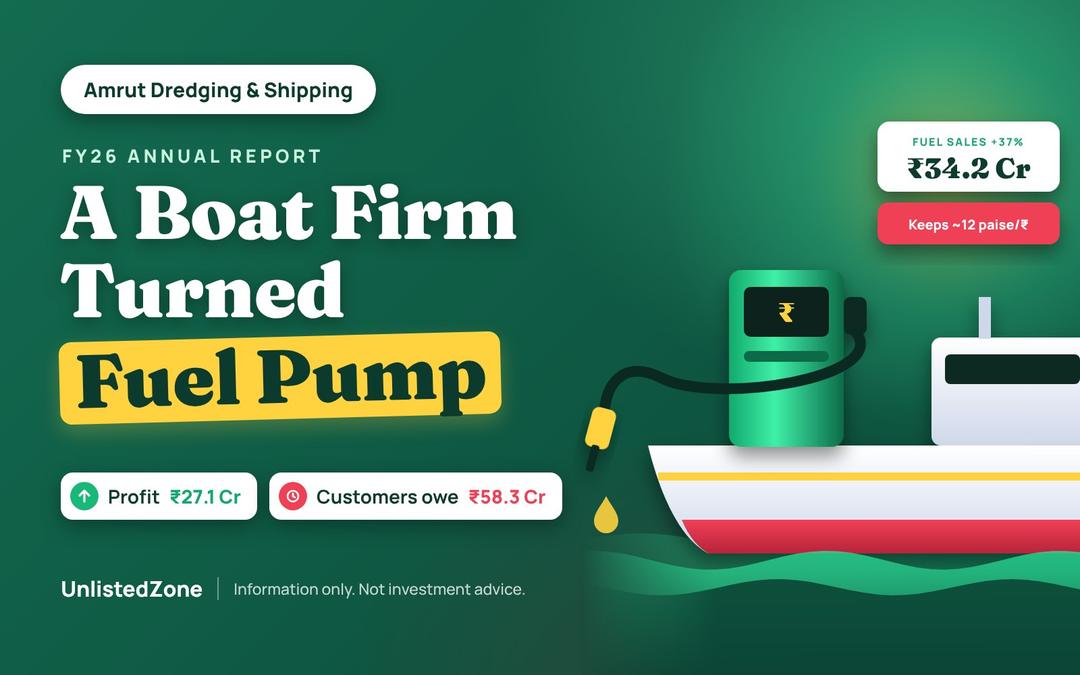
In today's story, we break down the FY2025-26 annual report of Amrut Dredging and Shipping, an unlisted Rajkot company that made ₹27 crore in profit last year by renting out boats and selling fuel at sea.
Picture a big cargo ship anchored a few kilometres off the Gujarat coast. It can't just pull into a petrol pump when it runs low on fuel. Its crew needs drinking water. The contractor working on the port next door needs a tug, a barge or a dredger for a few months, but doesn't want to buy one.
Someone has to show up with all of that. That someone is often a small, unglamorous marine services company. Amrut Dredging and Shipping, set up in 1995, is one of them.
The company has just sent out the notice for its 32nd Annual General Meeting, to be held on 5 December 2026 in Rajkot. Along with it came a 135-page annual report. We read it so you don't have to.
Amrut makes money in two ways: it rents out its boats, and it sells fuel and water to ships at sea.
Revenue stream (₹ crore) | FY2024-25 | FY2025-26 | Change |
|---|---|---|---|
| Chartering | 34.6 | 43.1 | +25% |
| Fuel & lube oil sales | 25.1 | 34.2 | +37% |
| Fresh water sales | 4.3 | 3.6 | −16% |
| Dredging | 6.5 | 1.6 | −75% |
| Barging | nil | 1.0 | New |
| Total | 70.4 | 83.5 | +19% |
Chartering is the main business. Port operators and marine contractors hire Amrut's dredgers, barges, tankers and speed boats for a fixed period, crew included. Think of it as Ola for boats, except the rides last months. Revenue comes in steadily over the contract, which makes it fairly predictable.
Fuel is the floating petrol pump. Amrut buys fuel and lube oil and delivers it to vessels. It sounds big, but the margin is thin. It paid about ₹30 crore for fuel it sold for ₹34.2 crore, so it kept only around 12 paise of every rupee.
Water is the hidden gem. Fresh water cost Amrut under ₹1 crore and sold for ₹3.6 crore. Small business, fat margin.
Dredging and barging are tiny now. Dredging means digging silt out of ports and channels so ships can pass. Barging, moving cargo on flat-bottomed boats, is new this year.
Revenue grew 19% to ₹83.5 crore, and profit after tax grew 23% to ₹27.1 crore.
(₹ crore) | FY2024-25 | FY2025-26 | Change |
|---|---|---|---|
| Revenue from operations | 70.4 | 83.5 | +19% |
| Other income | 6.0 | 4.7 | −22% |
| Total expenses | 56.6 | 61.0 | +8% |
| Profit before tax | 19.9 | 27.2 | +37% |
| Profit after tax | 22.0 | 27.1 | +23% |
| Earnings per share (₹) | 16.03 | 18.98 | +18% |
Profit before tax grew faster than profit after tax. That's because last year the company booked a one-off tax credit of about ₹2.3 crore, which made last year's after-tax profit look bigger than its pre-tax profit.
Where does the money go? The single biggest cost is buying the fuel it resells, about ₹30 crore. Then come depreciation on the boats (₹8.7 crore), interest on loans (₹5.1 crore) and salaries (₹4.5 crore). Once a vessel is bought, most of the charter rent it earns drops straight to profit. That's the beauty of an asset-heavy business when the assets are busy.
On ₹27.2 crore of pre-tax profit, Amrut paid current tax of just about ₹15 lakh. That's roughly 0.6%.
No, nobody forgot to file returns. Amrut has opted into the tonnage tax scheme. Under it, a shipping company isn't taxed on the profit it actually makes. Its income is instead calculated on the size (tonnage) of its fleet, and tax is paid on that deemed figure.
Think of it like a flat fee per truck instead of tax on every trip. If the trucks earn a lot, the fee doesn't go up. India brought in the scheme so that Indian shipowners could compete with foreign fleets registered in low-tax countries.
The company says all its income sources qualify as tonnage income. That's worth keeping an eye on, because fuel and water trading is almost half its revenue. The scheme also comes with conditions, such as setting aside part of profits in a reserve and training cadets. If Amrut ever drops out, its tax bill would look very different.
The profit is real, but the cash is slow to arrive, and the company is borrowing to grow.
Customers pay late. Very late. At the end of the year, customers owed Amrut ₹58.3 crore. That's about 70% of a full year's revenue, or roughly eight months of sales sitting unpaid. The company even earned ₹3.7 crore as interest on delayed payments, close to 14% of its pre-tax profit. Nice income, but it tells you how long the money takes to come in.
Cash is thin. Cash and bank balances were under ₹2 crore. Cash generated from operations was about ₹16 crore, well below the ₹27 crore of reported profit.
Debt has nearly doubled. Borrowings rose from ₹30.8 crore to ₹58.2 crore, and interest costs went from ₹2.2 crore to ₹5.1 crore. Against equity of ₹188 crore, that's a debt-to-equity of about 0.3, so it's still manageable.
A lot is still under construction. Amrut spent ₹50 crore on new assets this year. Capital work-in-progress, which means assets bought or being built but not yet in use, rose to ₹56.7 crore. For a shipping company, that usually means new vessels. These earn nothing until they hit the water.
The 'dredging' business has almost dried up. Dredging revenue fell from ₹6.5 crore to ₹1.6 crore. The company's name says dredging, but chartering and fuel now pay the bills.
The AGM is on Saturday, 5 December 2026, at 11 AM, at the registered office in Rajkot. From our read of the notice, shareholders will vote on:
Adopting the FY2025-26 accounts, the routine stuff.
Raising fresh money by issuing new shares, at a price no lower than an independent valuer's report.
Higher limits for borrowing, and for giving loans or making investments.
An item related to a director's appointment.
Put together, the message is simple: Amrut wants more capital, both equity and debt, to keep adding vessels. New shares mean your slice of the company gets a little smaller, so the issue price matters.
Now the valuation. In the unlisted market, the share is indicatively quoted at about ₹232. There are roughly 1.43 crore shares.
Metric | Value |
|---|---|
| Implied market value | ~₹331 crore |
| Price to earnings (P/E) | ~12x |
| Book value per share | ~₹132 |
| Price to book | ~1.8x |
| Return on equity | ~16% |
A P/E of 12 looks cheap on paper. But remember three things. The near-zero tax flatters profits. A big chunk of those profits hasn't been collected in cash yet. And unlisted shares are hard to sell quickly, since there's no exchange and the price is only indicative.
Amrut last raised money on 23 June 2025, at ₹160 a share. That valued the whole company at about ₹224 crore after the money came in.
The buyer wasn't an outside investor. It was the promoter and Managing Director, Pavan Gandhi, through a preferential allotment. He put in ₹4.6 crore for 2.875 lakh new shares.
Detail | Value |
|---|---|
| Date of allotment | 23 June 2025 |
| Price per share | ₹160 (₹10 face value + ₹150 premium) |
| Shares issued | 2,87,500 |
| Money raised | ₹4.6 crore |
| Allotted to | Pavan Gandhi, promoter and MD |
| Valuation before the raise | ~₹219.5 crore (1.37 crore shares) |
| Valuation after the raise | ~₹224.1 crore (1.40 crore shares) |
How was ₹160 decided? The law requires a registered valuer to set a minimum fair price for a preferential issue. Ahmedabad-based S G Marathe & Co. put it at ₹159.17 per share, as of 31 March 2025. They arrived at it by blending two methods:
Book value: what the company owns minus what it owes, about ₹108 a share. This got two-thirds of the weight.
Discounted cash flow: the value today of profits the management expects till FY2030, about ₹261 a share. This got one-third of the weight.
The share was issued just above that fair value, at ₹160.
Fast forward to today, and the unlisted market quotes Amrut at around ₹232. That's about 45% above the June 2025 price, and puts the company at roughly ₹331 crore against ₹224 crore then. In between, profit grew 23% and net worth crossed ₹188 crore.
One more thing. Share count rose by about 5.5 lakh during FY26, but this allotment explains only 2.875 lakh of them. So there may have been another allotment that isn't in the documents we have.
So yeah, Amrut is a quiet little marine company that has grown its profits nicely and pays almost no tax doing it. The open questions are whether it can collect its money faster, and whether the new vessels being built will earn enough to justify the extra debt and new shares. The AGM on 5 December won't answer all of that, but it'll tell us how much more capital the company plans to raise.
Until then…
Source: Amrut Dredging and Shipping Ltd, 32nd Annual Report, FY2025-26 (April 2025 to March 2026); list of allottees for the 23 June 2025 allotment; S G Marathe & Co. valuation report dated 29 May 2025. The report states figures in ₹ lakh; we converted them to crore (1 crore = 100 lakh) and rounded. Valuation figures are our own estimates using the ₹232 indicative price. This is for information only and is not investment advice.